A lithium-ion battery fire can fill a room with smoke in under two minutes. That’s the real reason a handful of states have spent the last three years rewriting their e-bike rules — not around helmets or speed limits, but around one blunt question: was this battery ever tested before someone sold it to you?
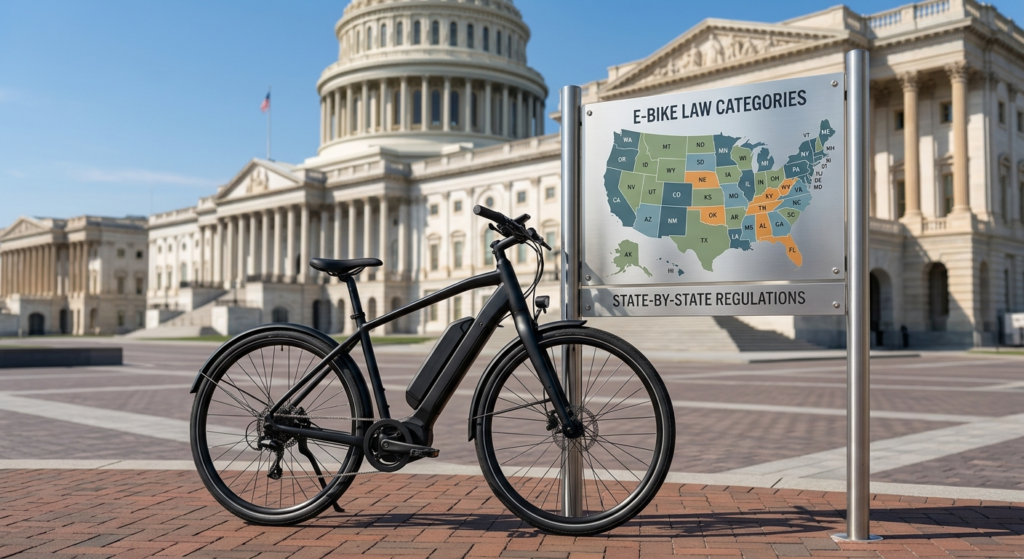
If you own an e-bike, sell them, or you’re just trying to buy a safe one, the answer now depends a lot on your zip code. California, New York, Colorado, Illinois, and Minnesota all have some form of battery law on the books in 2026. Most other states don’t — yet. This guide walks through exactly what each state requires, what “UL 2849” actually means, and what’s probably coming next. We’ll keep updating this page as more states act, so it’s worth bookmarking.
Why Every State Is Suddenly Writing E-Bike Battery Laws
E-bikes didn’t get more dangerous overnight. What changed is the flood of cheap, uncertified batteries on the market — especially replacement packs and DIY conversion kits sold online for a fraction of what a real manufacturer charges.
Federal regulators have tied hundreds of fires, dozens of deaths, and even more injuries to lithium-ion batteries in e-bikes and similar devices over the past several years. Insurance companies have noticed too — claims tied to e-bike battery fires roughly quadrupled between 2021 and 2025, according to industry data. Even big, trusted brands haven’t been immune. Rad Power Bikes, one of the best-known names in the US e-bike market, had a battery recall in 2025 after dozens of fire reports, some of which started while the battery was just sitting in storage, not even plugged in. If you want to see the specific brands and models that have actually been linked to fires, we’ve tracked which e-bike batteries have been catching fire in more detail.
New York City saw the problem first, and worst. The city logged well over a hundred lithium-ion battery fires in a single year before it passed the country’s first battery certification law back in 2023. Nearly every other state on this list has followed the same basic playbook since: stop trying to regulate how people ride e-bikes, and start regulating what’s inside them before they’re ever sold.
What UL 2849 Actually Means (and Why You Keep Seeing It)
You’ll see three codes over and over in this guide: UL 2849, UL 2271, and UL 2272. They sound like alphabet soup, but the idea behind them is simple.
UL stands for Underwriters Laboratories, a lab that’s been testing electrical products for fire safety since the 1890s — the same group that certifies your toaster and your phone charger. UL 2849 is their standard for an e-bike’s entire electrical system: the battery, the charger, the motor controller, and all the wiring connecting them. To pass, a bike has to survive being overcharged, short-circuited, crushed, and even soaked in water without catching fire or exploding.
UL 2271 is narrower. It only tests the battery pack itself, not the whole bike. UL 2272 covers e-scooters and similar devices instead of e-bikes. A few states also accept EN 15194, a similar European safety standard, as a stand-in for UL 2849.
None of this is self-certified. A bike or battery has to go through an outside lab and earn the mark before a company can legally call it certified. For the technical details straight from the source, UL Solutions has a plain-language breakdown of what UL 2849 actually tests.
E-Bike Battery Laws by State: The Full 2026 Table
Here’s where things stand, state by state, as of August 2026. This covers laws that specifically target battery or electrical-system certification — not general e-bike rules like speed limits or helmet requirements, which are a whole separate topic.
| State / City | Law | What It Requires | Status |
| California | SB 1271 | New e-bikes, batteries, and chargers sold or leased in the state must be tested by an outside lab to UL 2849 or EN 15194 | In effect since Jan. 1, 2026 |
| New York City | Local Law 39 | Any e-bike sold, leased, rented, or resold in the city must carry UL 2849 certification; batteries need UL 2271 | In effect since Sept. 2023 |
| New York State | 2024 lithium-ion battery law package | Bans selling lithium-ion batteries or chargers that don’t meet an accepted safety standard (UL, IEC, ANSI, or SAE) | In effect since late 2024 |
| Colorado | HB 25-1197 | Bans selling, leasing, or renting an e-bike lithium-ion battery — including rebuilt ones — unless it’s certified to UL 2849, UL 2271, or EN 15194 | In effect since Aug. 2025 |
| Illinois | Micromobility Fire Safety Act | Requires lab testing for e-bike drive systems and batteries; bans certain reconditioned batteries built from used cells | In effect since Jan. 1, 2026 |
| Minnesota | Statute §169.011 | A bike only legally counts as an “e-bike” if its battery has already passed independent safety testing | Ongoing |
| Florida | None yet | No statewide battery law; a broader e-bike safety bill passed unanimously, then was vetoed | No law |
| Most other states | None yet | No dedicated battery-certification law on the books, though a federal rule is now proposed | Watch this space |
A couple of things worth noting: these laws almost always target sellers and retailers, not people who already own a bike. And “in effect” doesn’t always mean fully enforced — a few of these are brand new as of January 2026, and enforcement tends to ramp up gradually over the following months.
A Closer Look at the States With Real Battery Laws
California
California’s rule, SB 1271, is the one the industry watches closest, since California is such a huge market. Starting January 1, 2026, any new e-bike, battery, or charger sold or leased in the state has to be tested by an outside lab and meet UL 2849 or EN 15194. The State Fire Marshal is also writing additional fire-safety rules to go along with it.
The law also closed a loophole manufacturers had leaned on for years — labeling a motor “750 watts” while quietly letting it peak much higher. Under SB 1271, 750 watts is now a hard ceiling. If you’re not totally clear on what actually separates a 500W bike from a 750W one, it’s worth a quick read before you shop.
Rental and bike-share fleets get a longer runway — that part of the law doesn’t kick in until January 1, 2028.
New York (City and State)
New York actually has two battery laws stacked on top of each other.
New York City moved first. Local Law 39 has required UL 2849-certified e-bikes and UL 2271-certified batteries since September 2023, for anything sold, leased, rented, or even resold within the five boroughs. It’s not retroactive — a bike bought before September 2023 is grandfathered in — but the FDNY has been aggressive about enforcement ever since, including shutting down shops that keep selling uncertified stock.
New York State followed about a year later. Governor Hochul signed a package of lithium-ion battery laws in July 2024, including a statewide ban on selling batteries or chargers that don’t meet an accepted safety standard. That same package requires warning tags on charging cords and mandates that first responders get specific training on battery fires.
Colorado
Colorado’s law, HB 25-1197, has been in effect since August 2025. It bans selling, leasing, or renting a lithium-ion e-bike battery — including a rebuilt or “second-use” one — unless it’s certified to UL 2849, UL 2271, or EN 15194.
The bill also made it illegal to advertise something as an “e-bike” if it doesn’t actually meet the legal definition, aimed squarely at the wave of speed-unlocked, moped-style electric bikes that only look like e-bikes. Selling a mislabeled one now counts as a deceptive trade practice, with fines up to $20,000 per violation.
Illinois
Illinois took a similar approach with its Micromobility Fire Safety Act, effective January 1, 2026. It requires lab testing for both the drive system and the battery pack of any low-speed e-bike sold in the state, and it specifically bans certain reconditioned batteries built from used lithium-ion cells.
Chicago actually got there first, passing its own city ordinance back in 2024 — years before the state followed with a law of its own. That city-first, state-second pattern shows up more than once on this list.
Minnesota
Minnesota does things a little differently. Instead of banning uncertified batteries outright, the state built the certification requirement right into the legal definition of an “electric-assisted bicycle.” Under Minnesota law, a bike doesn’t legally count as an e-bike — and doesn’t get the lighter-touch treatment e-bikes normally receive — unless its battery has already passed independent safety testing. Skip that step, and you’re arguably riding an unregistered motor vehicle instead.
🔧 From the Repair Bench
I used to get one question about e-bike batteries: “why won’t it charge?” Lately, more customers walk in holding their phone, asking whether the replacement pack they found online is even legal to install. That’s a real shift. My rule hasn’t changed, though — if a battery doesn’t have a certification mark stamped somewhere on the case, and the seller gets cagey when I ask about it, I won’t put it on a bike in my shop. I’ve seen what a swollen, no-name pack looks like right before it fails, and it’s not worth the forty dollars you saved buying around it.
States Without a Battery Law Yet — And What’s Coming
If your state isn’t in the table above, you’re not alone — most states don’t have a dedicated battery-certification law yet. That doesn’t mean nothing’s happening.
Florida came close this year. A bipartisan e-bike safety bill passed both the state House and Senate without a single “no” vote, then Governor DeSantis vetoed it in June 2026 over concerns about surveillance and government overreach. That particular bill was mostly about speed limits near pedestrians, not battery certification specifically, but it shows how fast this issue is moving even in states without a law on the books.
Massachusetts has a bill on the table too — the Ride Safe Act — which would tie legal e-bike status directly to UL certification, similar to what Minnesota already does. New Jersey, meanwhile, rewrote its e-bike rules from the ground up in 2026, but its focus was licensing and registration, not batteries specifically.
The pattern is pretty clear: a battery law tends to start in one big city, move to that city’s state government within a year or two, and then get copied somewhere else as a model bill. If your state doesn’t have one yet, it’s less a question of “if” than “when.”
Is There a Federal E-Bike Battery Law?
Not yet — but it’s closer than it’s ever been.
The Consumer Product Safety Commission (CPSC) is the federal agency that handles this, and it’s had a bumpy road getting here. In April 2025, the commission voted to move forward with a mandatory national battery standard. Weeks later, after the commission’s makeup changed, that vote got pulled back entirely.
Then, on June 24, 2026, the CPSC came back with a new proposed rule that would make UL 2849, UL 2271, and UL 2272 mandatory nationwide — for e-bikes, e-scooters, hoverboards, and even replacement battery packs and conversion kits, not just complete new bikes. You can read the details on the CPSC’s own micromobility safety page, and the public comment period runs through August 24, 2026.
Congress is working a separate track at the same time, with battery-safety bills that have already passed the House and cleared committee in the Senate. Nothing is final yet, but between the CPSC and Congress, most people tracking this issue expect some form of national standard within the next year or two.
How to Tell If Your E-Bike Battery Is Actually Certified
Whether or not your state requires it yet, here’s how to check:
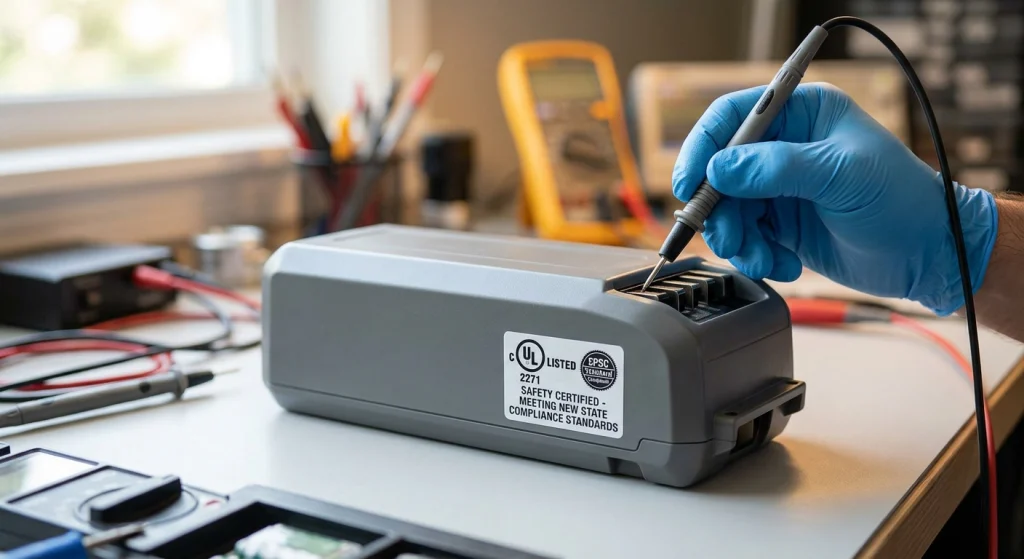
Look at the battery case itself, not just the box it came in. A certified pack usually has a UL 2849 or UL 2271 mark stamped or printed directly on it, along with the testing lab’s name. Listings and spec sheets should say so explicitly, too — if a listing is vague about certification, that’s usually because there isn’t any.
Ask for the test report. Under most of the state laws above, a seller is required to produce one if you ask. A shop that hesitates, changes the subject, or can’t produce paperwork is telling you something.
Be extra careful with replacement batteries and conversion kits. These are exactly the products several states above have singled out, since they’re often built from recycled or “second-use” cells with little real oversight. If a replacement battery costs half of what the manufacturer charges, ask why before you ask about shipping speed.
And if you’re not even sure the battery is your real problem, it’s worth ruling out a bad connection or dead charger before you assume you need a whole new pack — a real diagnosis first can save you from a purchase you didn’t need to make at all.
What This Means for You
- If you’re buying a new e-bike: check for certification before you check the color options. It should be printed clearly on the listing or spec sheet. For a fuller rundown of what else is worth comparing — motor type, range, frame fit — here’s what actually matters when you’re shopping for your first e-bike.
- If you’re buying secondhand: this is where these laws matter most. A private seller isn’t a licensed retailer, so the certification requirement may not technically apply to them — but the risk absolutely still does. Run through a proper pre-purchase checklist before handing over cash, and ask directly whether the battery is original or’s been swapped. If it’s a conversion kit bike, check whether that kit is even legal in your state first — several states now restrict them specifically because of battery quality.
- If you already own an e-bike: none of this means you need to replace a working battery. But if yours is getting old, there’s a real limit to how many charge cycles a lithium-ion pack can handle before performance — and safety — start to slide. When you do replace it, buy certified, even if your state doesn’t technically require it yet. And however you store your bike, cold weather affects battery health more than most riders expect, certified or not.
- If you sell or repair e-bikes for a living: these laws are only going to spread. Start asking your suppliers for test reports now, before your state makes it mandatory.
Frequently Asked Questions
What is UL 2849?
It’s a safety test for an e-bike’s whole electrical system — battery, charger, and motor — run by an outside lab. It checks that the bike won’t catch fire under stress, like overcharging or a short circuit.
Which states require UL-certified e-bike batteries?
As of August 2026: California, Colorado, Illinois, and New York (plus New York City) all have laws requiring certified batteries. Minnesota folds the requirement into its e-bike definition. Most other states don’t have a law yet.
Is it illegal to own an uncertified e-bike battery?
In most places, no. These laws target sellers and retailers, not riders who already own a bike — NYC’s law, for example, grandfathers in bikes bought before September 2023. But selling, leasing, or reselling an uncertified one where it’s banned can carry real fines.
Do these laws cover conversion kits and replacement batteries?
Increasingly, yes. Colorado and Illinois both specifically restrict rebuilt or “second-use” batteries, and the federal CPSC proposal would cover replacement packs and conversion kits too, not just complete new bikes.
How can I tell if my e-bike battery is actually certified?
Look for a UL 2849 or UL 2271 mark stamped on the battery or printed on the box, along with the testing lab’s name. If a seller can’t produce a test report on request, treat that as a red flag, not a formality.
The Bottom Line
E-bike battery law is one of the fastest-moving corners of transportation policy in the country right now, and this page will keep changing right along with it. The short version: five states have real battery-certification laws in 2026, a federal rule is genuinely on the table for the first time, and even in states with no law at all, the direction is obvious.
You don’t have to wait for your state to catch up. Buy certified, ask questions before you buy secondhand, and don’t let a bargain-bin replacement battery talk you out of doing both. It’s the difference between a battery that’s been tested to fail safely — and one that’s never been tested at all.