Buying your first electric bike can feel a little like buying your first car. There are numbers everywhere — watts, volts, amp-hours — and every salesperson swears their bike is the best one on the lot.
Take a breath. You don’t need an engineering degree to pick the right e-bike. You just need to know what each part actually does for you once you’re out on the road.
This guide walks through everything worth checking before you spend your money, in plain language, so you shop with confidence instead of guesswork.
Start With How You’ll Actually Use It
Before you look at a single spec sheet, picture your typical ride.
Are you commuting five miles to work on paved roads? Hauling groceries and kids around town? Hitting dirt trails on weekends? Or just cruising the neighborhood for fun? Your answer shapes everything else on this list.
A commuter wants a comfortable, upright seating position, fenders, and enough range for a round trip without anxiety. A trail rider wants suspension and tough tires. Someone running errands wants cargo space and a strong motor for stop-and-go hills.
There’s no single “best” e-bike — only the best one for your specific rides. Lock this answer in first, and every choice after this gets easier.
Learn the E-Bike Classes (and Check Your Local Laws)
In the U.S., e-bikes are sorted into three classes, and the class affects where you’re legally allowed to ride.
- Class 1 only assists while you pedal, and stops helping at 20 mph. No throttle.
- Class 2 also tops out at 20 mph but adds a throttle, so you can move without pedaling at all.
- Class 3 assists up to 28 mph through pedaling only, no throttle.
Class 1 bikes get the widest access — bike paths, city streets, and many mountain bike trails. Class 3 bikes are faster but often banned from multi-use trails. Rules shift by city and state, so it’s worth a quick check before you buy, especially if you’re eyeing a more powerful model.
This matters even more if you’re considering a conversion kit instead of buying new, since the legal limits on power and speed for converted bikes can be stricter — our breakdown of whether electric bike conversion kits are legal walks through what most states actually require.
Motor Power and Placement: Hub vs. Mid-Drive
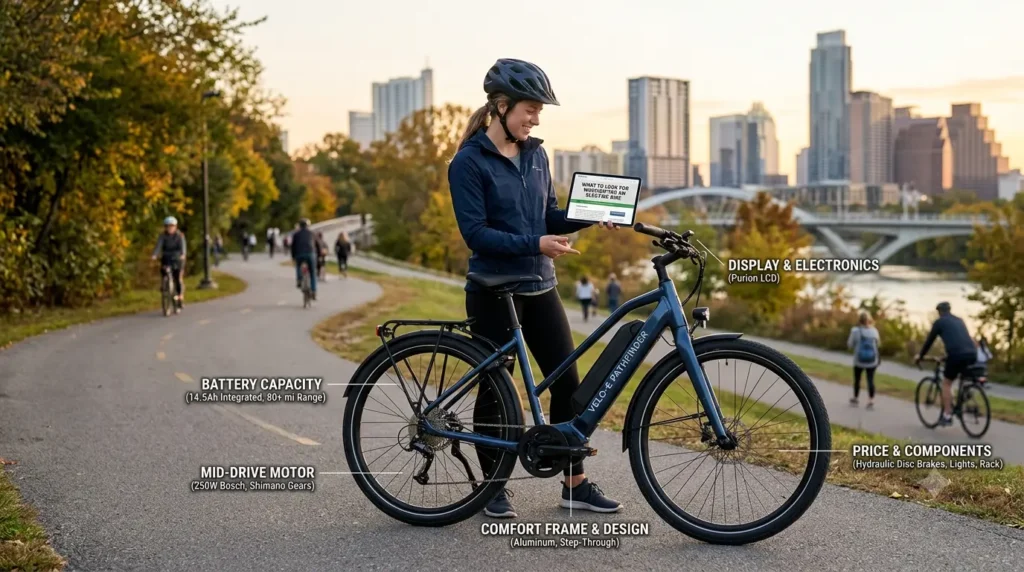
Every e-bike motor lives in one of two spots. A hub motor sits inside the front or rear wheel and pushes that wheel directly. It’s quieter, simpler, and usually cheaper.
A mid-drive motor sits at the pedals and pushes power through the bike’s existing gears. That makes it feel more natural and gives better hill-climbing performance, since it can use your gearing to its advantage.
Wattage tells you the motor’s everyday power (250–750W covers most riders), while torque, measured in Newton-meters, tells you how strong the push feels when you’re starting from a stop or grinding up a hill.
If your commute or errands route includes real hills, torque deserves more of your attention than top speed. We go deeper on this exact comparison in our piece on which e-bike has the most torque.
Battery Range and Charging: What the Numbers Really Mean
Range claims on the box are best-case numbers, not guarantees. Real range depends on your weight, the terrain, the wind, the temperature, and how much assist level you use.
Riding in the highest power mode on a hilly route will drain a battery far faster than cruising flat ground in eco mode — and pedal-assist settings genuinely change how much work the motor is doing for you, which we cover in our guide to how much assistance an e-bike actually gives.
Two numbers matter most: voltage (higher means more power available) and amp-hours or watt-hours (higher means more total energy stored, similar to a bigger gas tank). A 48V battery with a higher amp-hour rating will generally out-range a 36V battery of the same size.
Also check whether the battery is removable. Removable batteries are easier to charge indoors and swap if you want a spare, which matters a lot if you live in an apartment without an outdoor outlet.
Frame Style and Fit: Comfort Comes First
A step-through frame (no top bar) is easier to mount and dismount, which is great if you carry bags, have knee or hip issues, or just want quick stops on your commute. A step-over frame is typically stiffer and slightly lighter.
Frame material matters too. Aluminum is the most common choice — light and affordable. Steel is heavier but tough and absorbs bumps well. Carbon fiber is the lightest and priciest, usually overkill unless you’re chasing performance.
Fit is non-negotiable. A bike that’s the wrong size will feel awkward no matter how good the motor is. The same height-and-inseam approach used for sizing a regular bike applies here — our guide to finding the right mountain bike size breaks down exactly how to measure yourself and read a size chart, and the same logic carries straight over to e-bikes.
Credit: shopvelofix.com
Brakes, Tires, and Suspension
E-bikes are heavier and often faster than regular bikes, so braking power matters more, not less. Hydraulic disc brakes stop more reliably in wet weather and need less hand strength than mechanical (cable) disc brakes — worth the upgrade if it’s offered.
Tire choice changes your ride more than people expect. Wider, fatter tires add stability and a smoother feel over rough pavement, gravel, sand, or light snow, at the cost of a bit more rolling resistance on smooth roads. If your routes are mixed surfaces or you ride through winter weather, it’s worth understanding the real tradeoffs — we cover this in detail in our guide to the benefits of fat tires on a bicycle.
Suspension (front fork, or full front-and-rear) smooths out bumps on trails and rough city streets. Skip it if you’re sticking to smooth pavement; it adds weight and cost you don’t need.
Weight and Portability
Here’s something a lot of first-time buyers don’t expect: e-bikes are heavy. Most weigh 50 to 80 pounds with the battery installed, thanks to the motor and battery pack. That matters if you live somewhere with stairs, need to lift it onto a car rack, or want to carry it onto a train.
If storage space or portability is a real concern, a folding e-bike is worth a look. They tip the scales toward convenience, though usually with a smaller battery and shorter range as a tradeoff — our complete guide to the pros and cons of folding e-bikes lays out exactly what you give up and gain by going compact.
Extra Features Worth Paying For
Once the core specs check out, a few extras genuinely earn their keep: integrated lights (you’ll actually use them, unlike clip-ons you forget to charge), fenders if you ride in rain, a rear rack if you carry anything, and a clear display showing speed, battery level, and assist mode.
Security is worth budgeting for too, since e-bikes are a known theft target because of their resale value. A solid lock — not the cheap cable that came with your last bike — is one of the better dollars you’ll spend; our review of the best bike locks for e-bikes breaks down what actually holds up against modern theft tools.
Warranty and Local Support
Look for at least one to two years of coverage on the motor and battery, and check whether the frame warranty is longer. Just as important: does a shop near you actually service this brand? E-bikes have electronics that DIY repair can’t always fix, and a bike that’s cheap to buy but impossible to get serviced will cost you more in the long run. Buying from a shop that’s genuinely invested in e-bikes — not just one with a couple of dusty floor models — tends to pay off the first time something needs adjusting.

Credit: www.cyclingelectric.com
Setting a Budget: What You Get at Each Price Point
- Under $1,200: Basic hub motor, smaller battery, value components. Fine for flat commutes and light use.
- $1,200–$2,500: The sweet spot for most riders — better batteries, hydraulic brakes, and often a choice between hub and mid-drive.
- $2,500+: Premium motors, larger batteries, lighter frames, and smart connectivity. Worth it if you ride often or tackle serious hills.
If budget is tight, it’s worth knowing that some manufacturers, community programs, and even employers offer free or discounted e-bikes through sustainability initiatives — our guide on how to get an electric bike for free covers legitimate routes worth checking before you pay full price.
Test Ride Before You Buy
Specs on paper can’t tell you how a bike feels under you. Test ride before you commit, even if it means a short detour to a local shop. Pay attention to how the brakes respond, whether the seat and handlebars feel right for your body, how the motor kicks in (smoothly or with a jolt), and whether the bike feels stable at low speed. If a shop won’t let you test ride, that’s a signal worth noticing.
When and Where to Buy for the Best Deal
Timing your purchase can save real money. Prices tend to drop in late fall and winter as demand slows, and end-of-model-year sales clear out older inventory at a discount. The two biggest annual sales events are well known for steep markdowns, but they each work a little differently depending on whether you shop online or in person — our comparison of Black Friday vs. Cyber Monday bike deals breaks down which day tends to offer the better deal depending on what you’re shopping for.
Common Mistakes First-Time Buyers Make
A few patterns show up again and again with new e-bike owners. Buying on price alone and ending up with an underpowered motor or a battery that can’t handle the daily route. Skipping the test ride and discovering the fit is wrong after the return window closes. Ignoring the weight limit listed in the specs, which covers both rider weight and any cargo. And buying a bike without checking whether a local shop can actually service it later.
Frequently Asked Questions
How much should I spend on my first electric bike?
Most reliable first e-bikes start around $1,200–$1,500. Going much cheaper usually means a weaker motor, smaller battery, and lower-quality brakes.
What’s the difference between Class 1, 2, and 3 e-bikes?
Class 1 and 2 top out at 20 mph (Class 2 adds a throttle); Class 3 assists up to 28 mph through pedaling only. Class limits where you can legally ride.
Is a hub motor or mid-drive motor better?
Hub motors are simpler and cheaper; mid-drive motors climb hills better and feel more natural. Choose based on your terrain, not just price.
How far can an e-bike go on one charge?
Most e-bikes get 20–50 miles per charge, but real range depends on rider weight, terrain, wind, and assist level used.
Do I need a license to ride an electric bike?
In most U.S. states, Class 1 and 2 e-bikes don’t require a license. Some states have extra rules for Class 3 bikes, so check local laws first.
Final Thoughts
Buying an electric bike doesn’t need to be overwhelming once you break it into pieces: how you’ll ride it, what class fits your routes, what motor and battery suit your terrain, and what your budget actually buys at each price point. Get those answers locked in, take a test ride, and you’ll walk away with a bike that actually fits your life — not just one that looked good in an ad.