You’re cruising down a flat road, the wind’s in your face, and you’re wondering — what if I just stopped pedaling entirely? Would the bike keep going? How far could it actually take me?
It’s a question a lot of e-bike owners ask, and the answer is more interesting than you might expect. Because it’s not just about battery size. Your bike’s class, your speed, the terrain, even the weather — all of it plays a role.
This article breaks it all down in plain language. By the end, you’ll know exactly how far you can go, what slows you down, and how to squeeze every mile out of your battery when you’re letting the motor do the heavy lifting.
Can Every E-Bike Be Ridden Without Pedaling?
Here’s something that surprises a lot of new riders: not every e-bike lets you ride without pedaling at all.
In the U.S., electric bikes are grouped into three classes. That class determines whether you get a throttle — and the throttle is what lets you ride without moving your feet.
- Class 1 bikes are pedal-assist only. The motor activates when you pedal, and it cuts off at 20 mph. There’s no throttle. If you stop pedaling, the motor stops too.
- Class 2 bikes are the ones you want if you plan to ride hands-free (or feet-free, in this case). These have a throttle — usually a thumb lever or a twist grip — that lets the motor propel you without any pedaling. Motor-assisted speed is capped at 20 mph, but you can still go faster by pedaling on top of that.
- Class 3 bikes offer stronger pedal assist up to 28 mph and are designed for faster commuting. Most don’t come with a throttle. Some are dual-classified and include a throttle limited to 20 mph, but it’s not the standard.
So the short answer is: you can only ride truly without pedaling on a Class 2 e-bike equipped with a throttle. If your bike is Class 1, you’ll need to keep those legs moving to keep the motor alive.
Not sure what class your bike is? Check the label on the frame — most manufacturers are required to include it. If you’re still shopping and want to know what to look for before buying, there’s a solid breakdown of what to look for when buying an electric bike that covers this and more.
So How Far Can You Actually Go?
Now for the number everyone really wants.
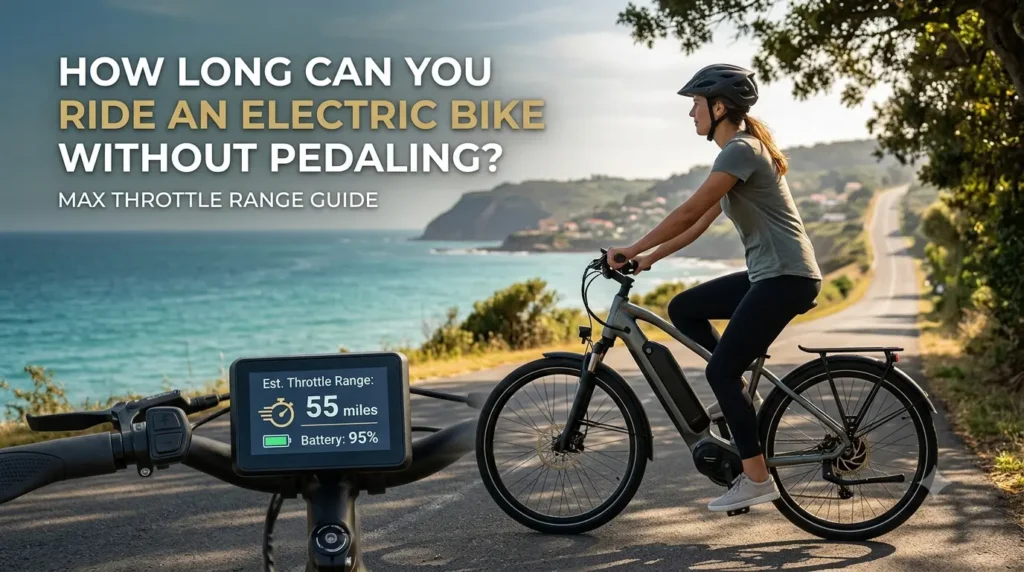
On throttle-only mode with no pedaling, most e-bikes will travel somewhere between 20 and 35 miles on a full charge. High-performance models with dual batteries or oversized packs can push that to 60 miles or more — but that’s not the average.
Sixthreezero actually put this to the test in a real-world ride. Two bikes — a 250W and a 500W model — were ridden at full throttle with zero pedaling until the batteries died. The 250W bike clocked 22.4 miles. The 500W bike hit 15.7 miles, but spent a lot more time climbing hills, which killed the battery faster.
Here’s a more general breakdown based on battery capacity:
- A 15Ah battery on a typical 750W bike: around 25–30 miles on throttle only
- That same battery with moderate pedal assist: 40–50 miles
- A 700Wh battery at sustained high throttle: roughly 20–28 miles
- At moderate pedal assist: 40–60 miles
The lesson is clear. Throttle-only riding is real and functional — but your battery won’t last nearly as long as the manufacturer’s claimed range suggests, because those numbers are almost always based on pedal assist.

The Key Factors That Affect Your Throttle Range
Your battery capacity matters, but it’s not the only thing in play. Here’s what’s actually cutting into (or protecting) your range when you ride throttle-only.
Hills
This is the biggest one by far. When you’re climbing a hill on full throttle with no pedaling, your motor is under maximum sustained load. It has to fight gravity, your full body weight, and the bike’s weight — all while drawing massive current from the battery. In the Sixthreezero test, a single hill knocked off a full battery bar. Long climbs on throttle can literally overheat a hub motor if you’re not careful.
Your weight
More mass means more motor effort to get you moving and keep you there. If you’re a heavier rider or you’re carrying cargo, expect your range to drop noticeably compared to the numbers you see in marketing materials.
Your speed
This one surprises people. Going from 15 mph to 20 mph on throttle doesn’t just use a little more battery — it uses a lot more. Wind resistance grows exponentially with speed. Real-world testing shows that riding at your e-bike’s top throttle speed can cut your range nearly in half compared to a comfortable cruise at 13–15 mph.
Cold weather
Lithium-ion batteries run less efficiently when it’s cold. Below 40°F, you can lose 20–30% of your normal range. In freezing conditions, some bikes enter a Low Temperature Protection Mode and limit power delivery entirely. This is one reason why it’s smart to think carefully about how to store your electric bike in winter — battery health outside of riding season affects your range when you get back on.
Tire pressure
Under-inflated tires create rolling resistance. The motor has to work harder to push through that resistance, burning more battery. It’s a small detail that adds up quickly over 20+ miles.
Terrain type
Sand, gravel, or rough trails demand significantly more motor power than smooth asphalt. If you’re riding off-road, throttle range shrinks fast compared to road riding.
Acceleration habits
Every time you twist the throttle from a dead stop, you’re hitting the battery with a high-current spike. Smooth, gradual acceleration is always kinder to your battery than jackrabbit starts from intersections.
Throttle vs. Pedal Assist — What’s the Real Difference for Your Battery?
The gap in range between throttle-only and pedal assist is bigger than most riders realize.
Real-world tests consistently show that throttle-only riding reduces battery range by 40–50% compared to riding with pedal assist at moderate levels (PAS 2 or 3). A battery that gives you 40–60 miles with pedal assist might only give you 20–30 miles on throttle alone.
Why such a big gap? The math is simple. With pedal assist, your legs are contributing energy to moving the bike forward. The motor only needs to fill the gap — not carry the whole load. That makes the system dramatically more efficient.
With throttle, the motor carries everything. Every mile you travel comes 100% from the battery. There’s no human contribution at all, and the battery drains accordingly.
Smart riders use a hybrid approach: throttle for the moments that need it (starting from a stop, tackling a steep section, cutting through a headwind), and pedal assist for everything else. This strategy gives you the convenience of both modes while preserving battery for when you truly need a break.
If you want to dial in how much power you’re actually getting from different assist levels, it helps to understand how much assistance an e-bike actually gives at each setting — the difference between PAS 1 and PAS 4 is bigger than you’d expect.
Will Throttle-Only Riding Damage Your E-Bike?
This is a fair thing to wonder about. And the good news is that for most flat riding, the answer is no — throttle use isn’t inherently harmful to your motor.
The risk shows up in a specific scenario: long, steep climbs at full throttle with no pedaling.
Here’s what happens. On a steep hill, the motor slows down while drawing peak current to fight gravity. That combination — high current draw at low motor speed — generates a lot of heat. E-bike motors are built to handle heat to a point, but sustained hard climbs on throttle push hub motors into dangerous territory fast.
Hub motors (the kind mounted in the wheel) are especially vulnerable because they’re enclosed with limited airflow for cooling. If the motor gets hot enough, the bike’s controller will trigger a thermal cutoff — essentially a fail-safe that cuts power until the motor cools down. On cheaper bikes, repeatedly pushing a hub motor to this limit can damage the internal windings over time.
Mid-drive motors handle hills better because they work through the bike’s gear system, which helps keep the motor spinning efficiently even on climbs. But they’re not immune to heat either.
The easy fix: pedal on hills. Even light leg effort dramatically reduces the motor’s workload and heat buildup. If you’re on a long, brutal climb and you feel the motor struggling, stop for a few minutes. Most motors cool down within 2–5 minutes of rest.
Smart Tips to Stretch Your Throttle Range
You can’t change the laws of physics, but you can work with them.
Ride at a comfortable cruise speed. The efficiency sweet spot for most e-bikes is between 13 and 18 mph. At 20 mph on throttle, you’re burning significantly more power to push through air resistance. Backing off just a little can add meaningful miles.
Use the hybrid approach. Get rolling with a short throttle burst, then switch to pedal assist for the bulk of your ride. This protects your motor from cold-start current spikes and extends your battery life considerably.
Plan flat routes when throttle matters. If you’re doing a longer trip on throttle only, route-planning around flat terrain will get you noticeably farther than hill-heavy routes.
Keep tires properly inflated. It takes two minutes and costs nothing. Proper pressure means less rolling resistance and a longer range.
Don’t ride the battery to zero. Running a lithium battery to complete empty stresses the cells. Try to charge when you’re around 20–30% remaining. Wondering how many cycles your battery can actually handle? There’s a useful guide on how many times you can charge an electric bike battery before the capacity starts to drop.
Let your battery cool before charging after a hard ride. Charging a warm battery accelerates cell wear. Give it 15–30 minutes after a demanding throttle session before you plug it in.

Is It Legal to Ride Without Pedaling Where You Live?
In the U.S., throttle riding on a Class 2 e-bike is legal in most places — but not everywhere, and not always on every surface.
As of 2026, 36 states and Washington D.C. use the three-class system. Class 2 bikes with throttles are generally treated like regular bicycles — no license, no registration, no insurance required. You can ride them in bike lanes and on most bike paths.
But there are important exceptions:
- California allows Class 2 bikes on most paths, but restricts throttle use on specific non-motorized trails and nature areas. The motor must stay under 750W and the throttle-assisted speed must stay at or below 20 mph.
- New Jersey has reclassified all e-bikes as motorized bicycles, which means Class 2 bikes technically require a license and registration — a significant departure from how most states handle things.
- National parks generally allow Class 1 and 2 e-bikes on paved trails and roads. Class 2 bikes (with throttles) are often restricted on non-motorized backcountry trails even where Class 1 bikes are permitted.
Some public trail systems and multi-use paths also post their own rules that go beyond state law. When in doubt, check the signage or contact your local parks department before you ride.
What Happens When the Battery Runs Out Mid-Ride?
Picture this: you’ve been riding throttle-only for a while, and you notice the motor starting to fade. Speed drops. The display shows one blinking bar. What now?
Most e-bikes manage the final stretch gracefully. As battery levels drop, the motor’s power delivery tapers off — you’ll feel the bike slowing before it cuts out entirely. Many bikes flash a low-battery warning on the display to give you some warning.
Once the battery is dead, the motor stops. But the bike itself doesn’t stop. You can still pedal it like a regular bicycle. The pedals still turn, the wheels still roll. It’s just heavier than you’re used to — most e-bikes weigh 40 to 70 pounds, so expect a workout.
This is worth planning for on longer rides. Know your approximate throttle range before you head out. If there’s any chance you’ll push the limits, bring a charger and know where you can stop to plug in. And if battery problems have been a recurring issue — unexpected cutouts, faster-than-expected drain — there’s a helpful breakdown of what happens when an e-bike battery dies and what might be behind it.
Frequently Asked Questions
How long can a Class 2 e-bike run on throttle only before the battery dies?
Most Class 2 e-bikes will cover 20 to 35 miles on a full charge using throttle only. High-end models with larger or dual batteries can reach 50 to 60 miles. Actual range depends heavily on rider weight, terrain, speed, and temperature.
Does using the throttle only damage my e-bike over time?
Not on flat ground. Throttle riding is fine for everyday use. The issue arises during long, steep climbs with no pedaling — that puts sustained heat stress on hub motors. Light pedaling on hills prevents this and protects your motor’s long-term health.
Is pedal assist or throttle better for making the battery last longer?
Pedal assist wins every time. Because your legs share the workload with the motor, the battery carries a smaller load and lasts significantly longer. Most riders get 40–50% more range in pedal assist mode compared to throttle-only riding.
What speed can I reach without pedaling on an e-bike?
On a Class 2 e-bike, the throttle caps motor-assisted speed at 20 mph. You can go faster by pedaling on top of the motor’s assist, but throttle alone maxes out at 20 mph under U.S. law. Exceeding that with motor power only puts your bike outside the standard legal e-bike classification in most states.
Can I ride an electric bike without pedaling if it’s a Class 1 or Class 3?
Not with motor assistance. Class 1 and Class 3 bikes use pedal-assist systems that only activate when you’re pedaling. If you stop pedaling, the motor stops. You can coast downhill or push the bike without pedaling, but the motor won’t engage without pedal movement on these classes.
Final Thoughts
So, how long can you ride an electric bike without pedaling?
If you have a Class 2 e-bike with a throttle and a decent battery, you’re looking at 20 to 35 miles on pure throttle. Ride on flat ground, keep your speed moderate, and stay away from long climbs, and you’ll hit the higher end of that range. Push uphill at full throttle or ride in cold weather, and expect less.
The biggest takeaway? Throttle is a fantastic tool — it’s one of the best parts of owning an e-bike. But it’s most powerful when you treat it as a supplement rather than your only mode. A smart mix of throttle and pedal assist will always get you farther than either mode alone.
Know your bike’s class, check your local laws, and take care of your battery. Do those three things, and you’ll always have the ride you’re counting on.