Your e-bike is acting up, and you don’t know why. Maybe it won’t turn on. Maybe it dies mid-ride, right when you need power the most. Maybe the throttle jerks like it’s trying to buck you off. Whatever’s happening, there’s a good chance someone’s already told you to blame the controller.
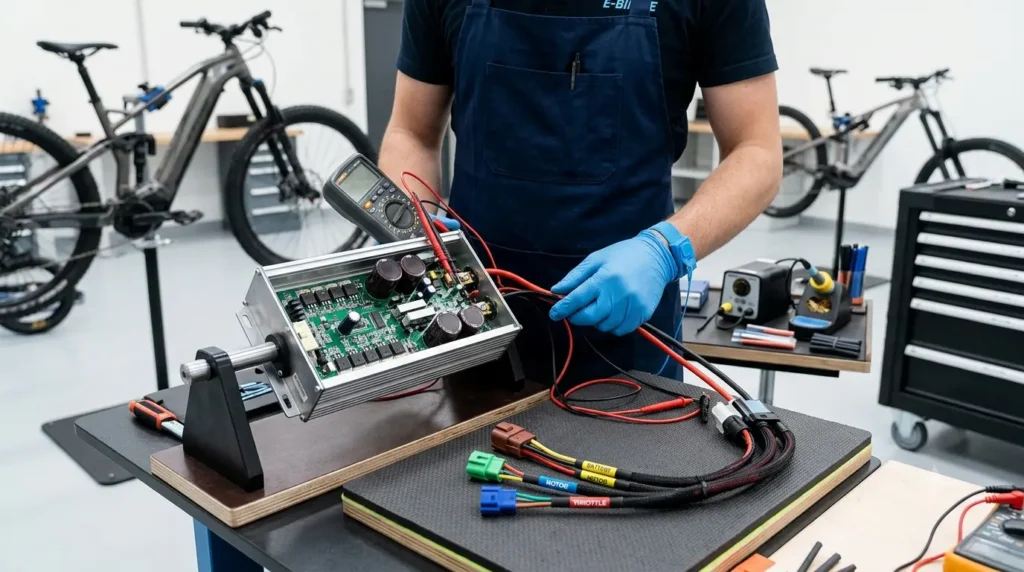
The controller is the small box that connects your battery, motor, throttle, and sensors. Think of it as the brain of your e-bike. It reads signals — how hard you’re pedaling, how far you’ve twisted the throttle, whether you’re squeezing the brakes — and decides how much power to send to the motor. So when something feels off, the controller is usually the first thing to get blamed.
Here’s the good news: most “e-bike controller problems” aren’t controller problems at all. A loose connector, a stuck brake sensor, or a blown fuse can cause the exact same symptoms as a fried controller, and those are usually simple, cheap fixes. This guide walks through the most common symptoms one at a time, so you can match what your bike is doing to what’s actually wrong, and fix it without guessing.
How to Tell If It’s Really the Controller
Before you shop for a replacement, do a quick gut check. A lot of what looks like a controller failure is really a battery problem, a loose wire, or something that has nothing to do with your electrical system at all.
Start here:
- Is the battery actually charged, and is it snapped in all the way? A battery that isn’t fully seated can act exactly like a dead controller.
- Does the display turn on at all? If it does, your controller is at least getting power, and that narrows things down a lot.
- Is the bike making noise but still riding fine? That’s a different problem. Squeaking, clicking, or grinding sounds point to something mechanical, not electrical.
If you’re not sure whether the battery itself is the real problem, working through how to check for a dead battery first can save you from replacing a controller that was never broken.
No Power at All: The Bike Won’t Turn On
This is the scariest one, because it feels like the whole bike just died. Take a breath. In most cases, it hasn’t.
Common causes:
- The battery isn’t seated all the way, or the connector between the battery and controller has come loose.
- A fuse has blown. Many e-bikes have a small inline fuse near the battery or controller, and it’s cheap and easy to check.
- The battery is genuinely dead or too low to wake the system up.
- Corrosion has built up on a connector pin, usually from a wet ride or a winter spent in a damp garage.
Start by popping the battery off and reseating it firmly, until you hear or feel it lock. Look at the connector pins for any green or white crust; that’s corrosion, and a little contact cleaner and a soft brush usually clears it. Check for a fuse and see if it’s blown. If your battery hasn’t been charged in a while, confirm it’s actually taking a charge before you assume the controller is the culprit.
If the display still won’t light up after all that, the wiring between the battery and controller is the more likely suspect, not the controller itself.
The Bike Cuts Out While You’re Riding
This is the most common complaint, and it’s also the most misunderstood one. The bike rides fine, then suddenly loses power, often right when you’re climbing a hill, hitting a bump, or pushing toward top speed.
A few things cause this:
- Your brake sensor is stuck “on.” Most e-bikes cut power the instant you touch the brakes, using a small sensor in the lever. If that lever doesn’t spring all the way back, or the sensor has shifted slightly, the bike thinks you’re braking even when you’re not.
- A connector is loose enough to lose contact only under vibration, which is why it seems to happen on rough roads or hard climbs but not when the bike is sitting still.
- Your battery is sagging under load. An aging battery can deliver power fine at a gentle pace, then dip below a safe voltage the moment you ask more of it, tripping a built-in safety cutoff.
- You’ve hit your bike’s speed limiter. If the power always cuts at the exact same speed, that’s not damage. That’s your bike doing exactly what it’s built to do.
- The controller or motor is overheating from sustained hard use and shutting itself down to cool off.
To check the brake sensor, squeeze each lever and let go slowly. Both should spring back to their resting position with nothing catching. To check for a loose connector, gently wiggle the main harness plugs while a friend watches the display, or while you’re stopped and can watch it yourself. If the cutout only happens near your bike’s top speed, that’s the limiter, not a fault.
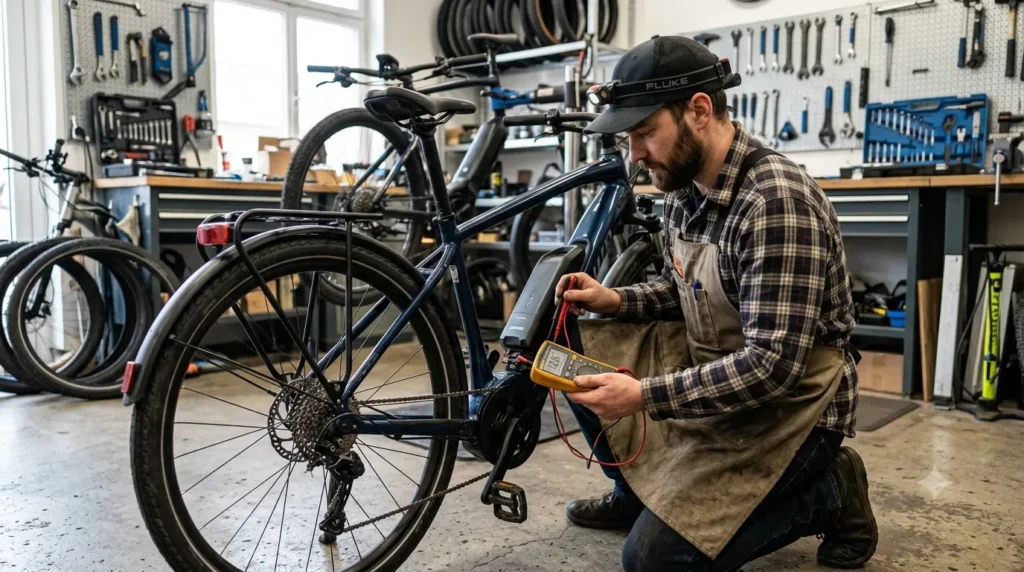
From the Repair Bench: Most of the “dead controller” bikes that came across my counter weren’t dead controllers at all. Nine times out of ten, it was a brake sensor that never fully reset, or a connector that had worked itself loose after months of bouncing over rough roads. I’d reseat every connector I could reach before I ever reached for a replacement part, and that alone solved more bikes than any actual controller swap I ever did.
Jerky or Surging Acceleration
If a twist of the throttle sends you lurching forward instead of easing you up to speed, a few things could be going on.
Some throttles are simply built as an on-off switch instead of a smooth dial. If yours has always felt this way, that’s probably just how the bike is designed, not a new problem. But if it used to feel smooth and now feels jumpy, look at these:
- A dirty or worn throttle connector, which can make the signal spike instead of ramping up evenly.
- A pedal-assist sensor that’s out of alignment. This sensor reads a small magnet ring near your pedals, and it needs to sit close and steady. Debris or a bump can knock it off.
- An overheating controller, which can deliver power unevenly right before it shuts down.
- The same voltage sag mentioned above, which can make power feel like it surges and drops instead of building smoothly.
Clean the throttle connector and check the gap around the pedal-assist sensor first. Those two checks fix a surprising number of jerky-acceleration complaints, and neither one needs more than a screwdriver and a rag.
An Error Code Shows Up on the Display
Here’s something worth knowing up front: there’s no single, universal list of e-bike error codes. Every brand, and sometimes every model, uses its own numbering. A code that means “brake signal issue” on one bike might mean something totally different on another.
That said, most codes fall into a few general buckets:
- Communication errors mean two parts of the bike, like the display and the controller, have stopped talking to each other. Usually a loose or damp connector.
- Current or voltage errors mean the controller is seeing power that’s too high or too low for what it expects.
- Sensor errors point to the throttle, pedal-assist sensor, or brake sensor sending a signal the controller doesn’t understand.
- Motor errors usually point to something inside the hub motor itself, like a failing internal sensor.
Write the code down exactly as it appears. Then check your bike’s manual or manufacturer app, since that’s the only place you’ll find an exact match for your system. Try a simple reset first: turn the bike off, remove the battery for about a minute, then reconnect and power up again. That clears a surprising number of minor glitches on its own.
One more thing worth knowing: your controller likely has a programming menu that can adjust things like current limits and throttle response. That’s a real tool for tuning your bike, but it’s not a quick fix for an error code. Modifying those settings is its own project with its own risks, and doing it blind while chasing an error code usually makes things worse, not better.
The Throttle or Pedal Assist Stops Responding
If one system stops working while the other still does, that actually helps narrow things down fast.
Check these, in order:
- Your ride mode settings. Some displays let you turn off the throttle or pedal assist entirely, and it’s an easy setting to bump by accident while adjusting something else.
- The brake sensor again. A stuck sensor can block both throttle and pedal assist at once, since it cuts power at the source.
- The connector for whichever system stopped working. The throttle and the pedal-assist sensor plug in separately, so a problem with one usually won’t touch the other.
If you mostly ride throttle-only, knowing how far your bike can realistically go without pedaling helps you tell a normal range limit apart from an actual fault.
Power Feels Weak or the Bike Feels Sluggish
This one’s sneaky, because nothing fails outright. The bike just feels like it’s trying less hard than it used to.
Before you worry about the controller, check your ride mode. Eco mode is designed to feel weaker, and it’s an easy setting to bump without noticing. If you’re already in your highest power mode and it still feels sluggish, the likely causes are:
- An aging battery that can’t hold voltage under load the way it used to.
- A current limit set lower than expected, sometimes from a firmware update or a setting that got changed.
- A partially failing sensor inside the motor, which can make it run rough and lose some punch without cutting out completely.
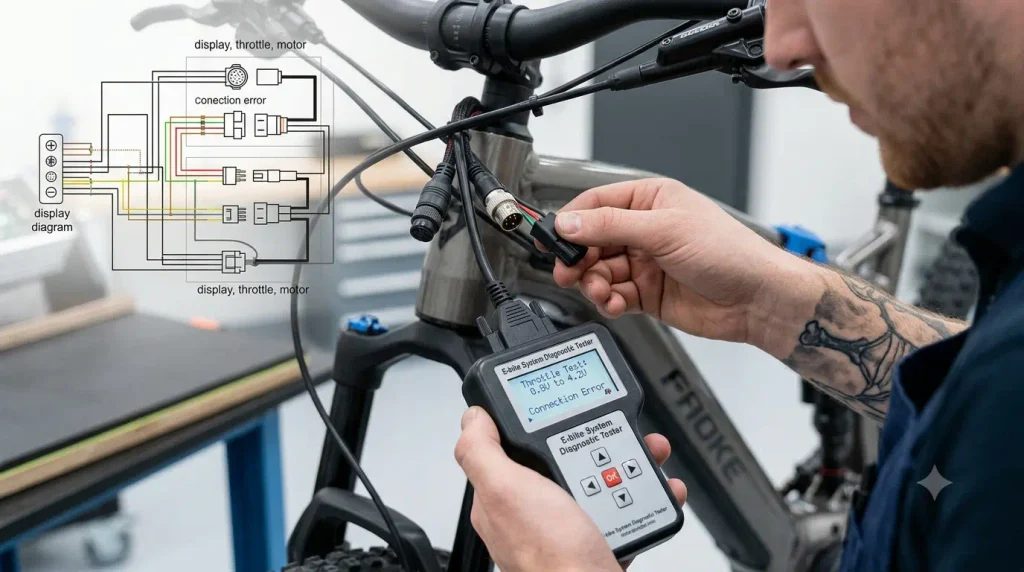
The Controller Feels Hot, Buzzes, or Smells Like Burning
Treat this one differently than the rest. Stop riding if you notice strong heat, a burning smell, or any melting or scorch marks near the controller.
This usually means one of a few things:
- The controller has been working harder than it’s built for, often from a steep climb, a heavy load, or a long stretch at full power with no break.
- Airflow around the controller is blocked, so the heat has nowhere to go.
- Water has gotten inside and caused a partial short.
- A component inside has actually failed, which is the one true “dead controller” scenario on this whole list.
Let the bike cool completely in a dry, ventilated spot, and don’t ride it again until it’s been checked out. This is the one symptom here where DIY troubleshooting should stop and a professional should take over, since you’re dealing with real electrical risk.
Should You Repair It or Replace the Bike?
If you’ve worked through the checks above and it really does look like the controller has failed, you’re not automatically looking at a huge bill. A basic controller typically runs $50 to $150, with premium or mid-drive systems climbing higher, plus another $50 to $150 in labor if a shop installs it for you.
Where it gets trickier is older or lower-end bikes. If a controller repair starts creeping close to half of what the bike is worth, it’s worth stepping back and asking whether that money is better spent on the repair or put toward something newer. Knowing what actually matters when you’re shopping for a bike makes that comparison a lot easier to make with confidence instead of guesswork.
Keeping Controller Problems From Coming Back
A little upkeep goes a long way. Wipe down connectors when you clean your bike, and skip pointing a hose or pressure washer straight at the controller housing. Store the bike somewhere dry when you can, since damp storage is one of the biggest hidden causes of the corrosion and connector trouble covered above. And don’t ignore small glitches. A cutout that happens once and never again is worth remembering, because it’s often the first sign of a connection working its way loose.
Frequently Asked Questions
What are the first signs of a failing e-bike controller?
Sudden power loss, jerky throttle response, an error code on the display, or a burning smell are usually the earliest warning signs.
Can I fix an e-bike controller myself?
Often, yes. Many “controller” problems are really loose connectors, a stuck brake sensor, or a blown fuse, and those are simple DIY fixes. Actual internal damage, like water intrusion or a burnt component, usually needs a professional.
Why does my e-bike cut out at higher speeds?
Most of the time, that’s your bike’s built-in speed limiter working exactly as designed. If the cutout happens below your bike’s rated top speed, look at the brake sensor or battery voltage instead.
How much does it cost to replace an e-bike controller?
Parts typically run $50 to $150 for a basic controller, with premium or mid-drive systems running higher. Add roughly $50 to $150 more if a shop installs it for you.
How do I reset my e-bike controller?
Turn the bike off, remove the battery for about a minute, then reconnect it and power the bike back on. This clears many minor glitches without erasing your saved settings.
Wrapping Up
Most e-bike controller problems don’t actually start in the controller. They start with a connector that worked loose, a brake sensor that never fully reset, or a battery that’s aging faster than you noticed.
Before you spend money on a new part, run through the checks that match what your bike is doing. It takes ten minutes, and it can save you from replacing something that was never broken in the first place.
If you’ve worked through the right section for your symptom and the problem is still there, at least you’re not guessing anymore. You’ll know exactly what to tell a shop, or exactly what part to order. That’s a much better place to be than staring at a bike that won’t move and hoping it fixes itself.