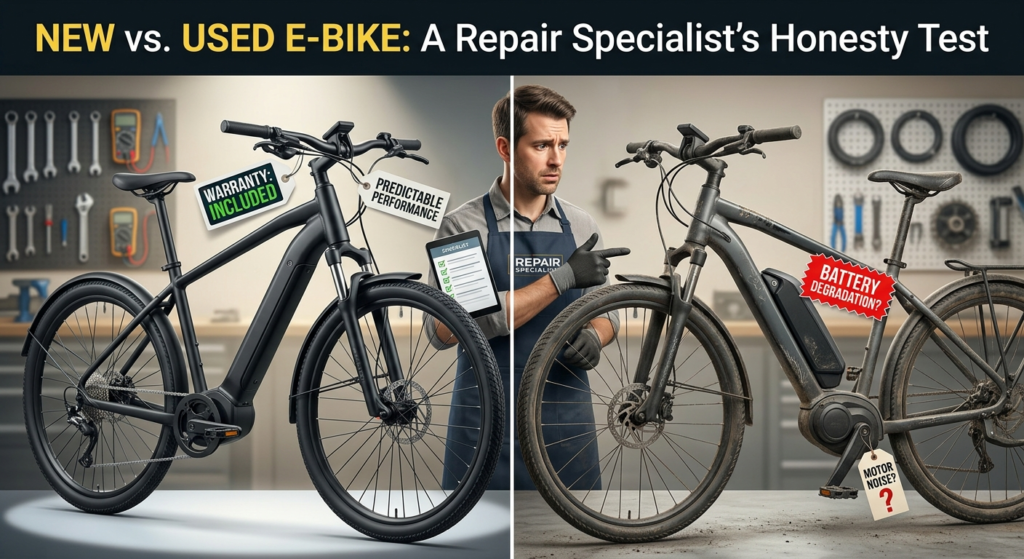
Last month, two e-bikes landed on my repair stand on the same afternoon. Both were about two years old. Both looked almost the same from across the shop. One had a battery with plenty of life left in it. The other needed a full battery replacement that cost almost as much as the bike sold for.
A used e-bike can be a smart buy, but only if you check the battery and motor yourself instead of trusting the listing. The battery alone can decide whether you got a deal or a $500 surprise.
So the real question isn’t “new vs. used e-bike” in some abstract way. It’s this: how do you tell which used bike you’re looking at? A regular bicycle is pretty forgiving. Worst case, you replace a chain or a set of brake pads. An e-bike has a battery, a motor, and a controller talking to each other, and any one of those can quietly wear out long before the frame does.
By the end of this guide, you’ll know exactly what I check every time a used e-bike rolls into my shop. Use the same list, and you’ll walk into any sale knowing more than most sellers do.
The Real Cost Breakdown: New vs. Used E-Bikes
What You’re Paying For With a New E-Bike
A solid new e-bike from a real brand usually runs somewhere between $1,200 and $3,000, depending on the motor, battery size, and features. That price gets you a battery at 100% of its real capacity, a full warranty, and a bike built to the newest safety standards. You also get to skip the guesswork this whole article is about.
New bikes lose value fast, though. Like a car, a new e-bike can drop 20 to 30% in value in its first year alone. That drop isn’t really about the frame or paint. It’s because buyers get nervous about a battery they can’t see inside of, and that nervousness shows up in resale price.
What You’re Really Saving (and Risking) With Used
That fast depreciation is exactly why used e-bikes look like such a good deal. You’ll typically find used bikes going for 30 to 50% less than their original price, sometimes more if the listing has sat for a while. That can mean an $1,800 bike for $1,000, which sounds like a clear win.
Here’s the catch: that price only makes sense if the battery still has real life in it. A pack near the end of its life can cost $300 to $800 or more to replace. Do that math before you get excited about the sticker price. A used e-bike’s true cost isn’t what you pay today. It’s what you pay today, plus whatever you’re likely to pay in the next year.
| Categories | New E-Bike | Used E-Bike |
| Price | Full retail | Usually 30–50% less |
| Battery | Full capacity, under warranty | Unknown until you test it |
| Warranty | Typically 1–2 years | Rare, often none |
| Biggest risk | Overpaying for features you won’t use | Inheriting someone else’s worn-out parts |
What Actually Degrades on a Used E-Bike
Battery Health: The Biggest Wildcard
An e-bike battery doesn’t fail all at once. It fades. Every time a battery goes from full to empty and back to full, that counts as one charge cycle, and most e-bike batteries are built to handle somewhere between 500 and 1,000 of those cycles before they start losing real capacity. For a rider who charges a few times a week, that works out to roughly three to five years of normal use.
Here’s what trips people up: the battery display can say 100% even when the pack is only holding a fraction of what it used to. The screen just means the battery is fully charged relative to whatever its current, shrunken capacity is. A two-year-old battery reading “full” might only carry you half as far as it did when new.
How to Do a Quick Used E-Bike Battery Check
You don’t need a repair shop’s tools to catch the obvious problems. Before you buy, do this:
- Look at the case. Any swelling, cracks, dents, or corrosion around the terminals means walk away, not negotiate.
- Ask for the charge-cycle count or total mileage if the bike has an app or display that tracks it. Brands like Bosch and Shimano often store this.
- Charge it and time it. If it takes noticeably longer than the manual says it should, that’s a sign of a tired pack.
- Ride it under real load, not just around the parking lot. Take it up a hill or run it on a higher assist level and watch how fast the range estimate drops.
- Check if it’s removable. A removable battery is easier to inspect closely and easier to replace later if you need to.
If the seller can’t or won’t let you do any of this, that tells you something on its own.
Motor Wear: Hub Motors vs. Mid-Drives
Motors don’t usually die out of nowhere either. They wear down through their bearings, the small parts that let the motor spin smoothly. A well-built hub motor bearing can last anywhere from 3,000 to 10,000-plus miles, or roughly three to ten years, depending on how much rain, dirt, and hard riding it’s seen. Mid-drive motors add gears into that mix, which means more parts that can wear and more reasons to listen closely.
The good news is that worn motors talk to you before they quit. Grinding, clicking, or a whine that gets louder under load are all signs of bearing wear. So is hesitation when the power kicks in, or the assist cutting in and out on a smooth road. A motor that runs silent and delivers power evenly, even under a hard pedal push, is a good sign. If you’re comparing specs between two used bikes, it also helps to understand how voltage differences like 36V and 48V actually change how a motor performs, since a higher number on paper doesn’t always mean a stronger ride.
From the Repair Bench
More than once, someone’s brought me a used e-bike for “just a battery replacement” that turned out to need a new controller too, because whoever charged it for years used a cheap third-party charger that slowly cooked the connection. A $40 charger swap early on would have saved them a $200 repair later. Always ask what charger came with the bike, and never assume the cheapest one is fine.
The Other Parts That Wear Out Faster on E-Bikes
Battery and motor get most of the attention, but I check three more things on every used e-bike: the drivetrain, the brakes, and the tires. E-bikes push more torque through the chain and cassette than a regular bike, so those wear out faster than you’d expect for the mileage. The extra weight of the motor and battery also means brake pads and tires wear down sooner. None of these are deal-breakers on their own, but a heavily worn drivetrain is a fair bargaining chip.
Red Flags to Check In Person Before You Buy
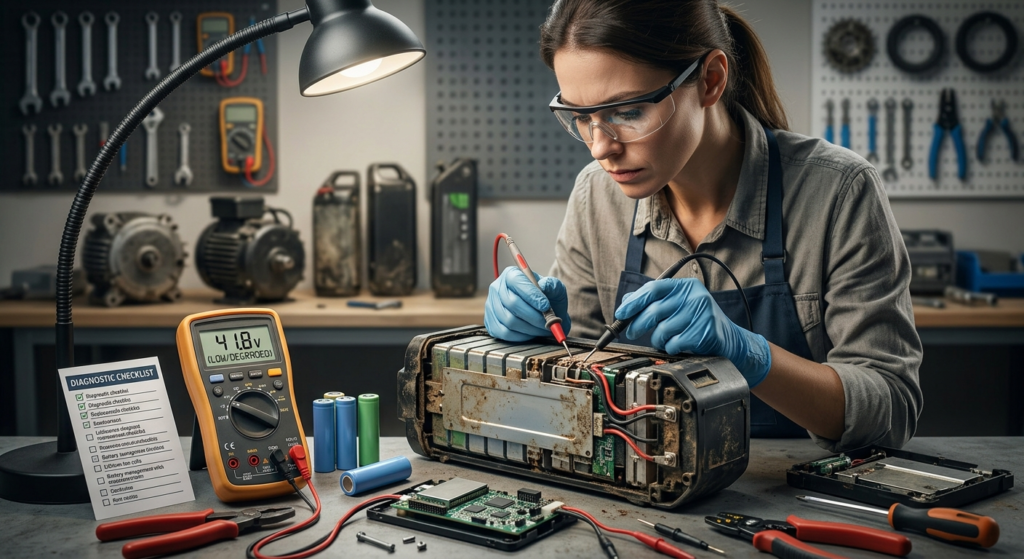
A photo and a good price can hide a lot. Here’s what I always check in person before money changes hands:
- The battery casing. Swelling, cracks, leaks, or a burnt smell are safety issues, not cosmetic ones.
- The original charger. A missing or mismatched charger is a real warning sign, not a minor inconvenience.
- Storage history. Ask how and where the battery was kept when not in use. A pack left in a hot garage or freezing shed all winter ages faster, and it’s worth knowing how a battery should actually be stored so you know what a good answer sounds like.
- The frame and fork. Look closely near the motor mount and headset for cracks or misalignment that could point to a past crash.
- A real test ride. Not a lap around the driveway. Get it up to speed, onto a hill if you can, and through every assist level.
- The seller’s answers. A seller who’s vague about age, mileage, or why they’re selling is telling you something, even if they don’t mean to.
- Certification and paperwork. Battery safety rules vary quite a bit by location these days, and a seller who can’t say anything about the battery’s safety certification is either uninformed or hiding something.
One red flag alone might be nothing. Three or four together mean you should probably keep looking.
When Buying Used Is Genuinely a Bad Idea
Used e-bikes are often a great choice, but not always. Here’s when I’d tell a friend to skip it:
- The seller won’t let you test ride it or see the battery charge. There’s no way to verify anything without this.
- The battery platform is discontinued and no replacement pack is available anywhere. A cheap bike with a dead-end battery isn’t a deal, it’s a paperweight in a year or two.
- The price is too close to a new bike’s price. If used savings are under 15 to 20%, you’re taking on all the risk of “unknown battery” for barely any reward.
- It’s had a DIY conversion or aftermarket kit installed. Unknown parts from unknown sources make both safety and future repairs much harder to predict.
- Multiple red flags are stacking up. Vague history, a sketchy charger, and a battery you can’t test together are worse than any one of those alone.
If any of that sounds like the bike you’re looking at, it might be worth starting fresh instead. Knowing what actually matters when shopping for a new e-bike can save you from overpaying there too.
FAQs About Buying New vs. Used E-Bikes
Should I buy a used electric bike?
Yes, if you can check the battery’s health and the seller has a clear history for the bike. Skip it if you can’t test the battery or the seller can’t answer basic questions about it.
What’s the biggest risk when buying a used e-bike?
The battery. It’s the most expensive part, the hardest to judge by looking, and replacing one can cost $300 to $800 or more.
How long will a used e-bike battery last after I buy it?
It depends on how many charge cycles it already has. A pack with 300 or more cycles on it may only have a year or two of good life left, not the full three-to-five-year lifespan of a new one.
Is a used e-bike actually cheaper in the long run?
Only if you don’t end up replacing major parts soon after buying. Factor in the likely cost of a battery or motor repair before comparing it to a new bike’s price.
What should I always ask a seller before buying a used e-bike?
Ask the battery’s age and charge-cycle count, whether the original charger is included, how it was stored, and why they’re selling.
So, Which One Should You Buy?
Here’s how I’d put it to a friend standing in my shop with this exact question. Buy used if you can verify the battery’s health yourself, the seller has a clear history and the original charger, and the price actually reflects real savings after accounting for a possible battery swap. Buy new if you want a warranty, zero guesswork, and you plan to keep the bike for years without wondering what the last owner didn’t tell you.
Neither choice is the “right” one across the board. A used e-bike with a healthy battery and an honest seller can be one of the best deals in cycling. A used e-bike with a tired pack and a seller in a hurry to sell can cost you more than buying new would have. The bike itself won’t tell you which one you’re looking at. The battery, the motor, and a few honest questions will.