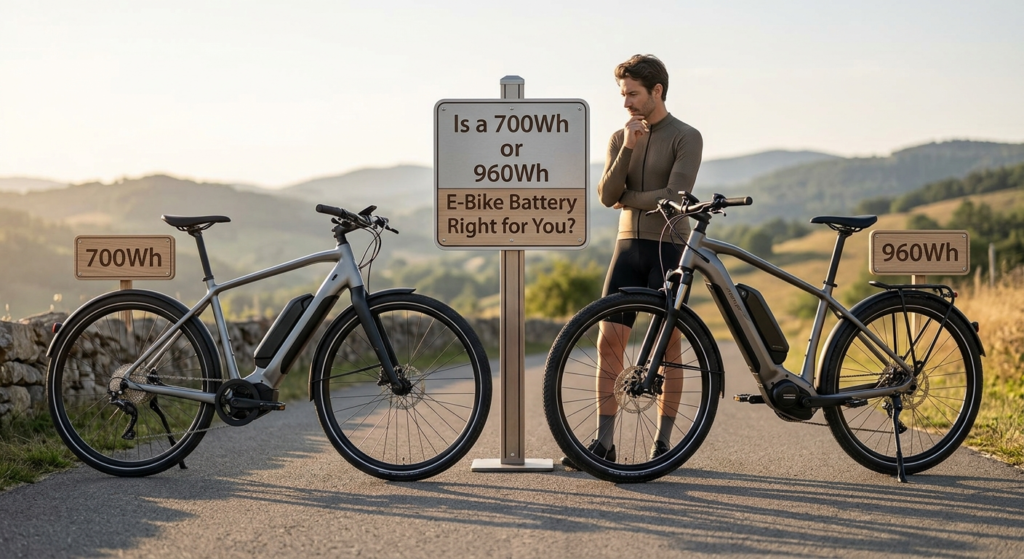
You’re comparing two e-bikes that look almost identical. Same frame. Same motor. Close enough on price. But one has a 700Wh battery, and the other has a 960Wh battery.
So which one do you actually need between 700Wh or 960Wh e-bike battery?
This is one of the trickiest calls in e-bike shopping, because it’s not like picking a color. The battery decides how far you can ride, how heavy the bike feels, how long you wait at the charger, and how much you hand over at checkout. Get it right, and you barely think about your battery again. Get it wrong, and you’re either babying a battery you never come close to draining, or watching the range bars drop faster than you’d like halfway through a ride.
Let’s walk through what these numbers really mean, so you can pick the right battery size for how you actually ride, instead of the biggest number on the shelf.
What Wh Actually Means (Quick and Painless)
Wh stands for watt-hour. It’s just a way to measure how much energy your battery holds, kind of like how a gas tank is measured in gallons.
Here’s the simple math behind it: Wh equals volts times amp-hours. A 48-volt battery with 15 amp-hours works out to about 700Wh. Bump that same 48-volt battery up to 20 amp-hours, and you land at 960Wh. Same voltage, bigger tank.
You don’t need to memorize that formula. Just know this: Wh is the number that tells you a battery’s true size, no matter what brand or voltage the bike uses. If you ever want to know what’s actually inside that battery case, most packs today use one of two cell types: the newer 21700 cells, which pack more punch into a smaller space, or the classic 18650 cells that have powered e-bikes reliably for years. Either one can hit 700Wh or 960Wh. It just depends on how many cells the maker packs in.
700Wh vs 960Wh: The Real Difference in Plain Numbers
Do the math, and a 960Wh battery holds about 37% more energy than a 700Wh battery. That sounds like a big jump, and on paper, it is.
But here’s what most spec sheets leave out: more stored energy doesn’t automatically mean 37% more range. Your real range depends on how fast you ride, how hilly your route is, how much you weigh, and how often you lean on the throttle instead of pedaling. Two riders on the exact same 960Wh bike can get wildly different mileage out of the same battery. One treats it like a gas tank to stretch. The other treats it like a power-up to burn through.
That’s why the next part matters more than the spec sheet number ever will.
Range Per Charge: What You’ll Really Get by Rider Weight and Terrain
Here’s a simple way to estimate your range: take your battery’s Wh number and divide it by how many watt-hours your bike burns per mile. Most e-bikes use somewhere between 10 and 35 Wh per mile, and where you land on that scale depends mostly on your weight, the terrain, and how much work the motor is doing.
Here’s how that plays out for both battery sizes:
| Riding Conditions | Wh Used Per Mile | 700Wh Range | 960Wh Range |
| Lighter rider, flat roads, low assist (mostly pedaling) | 10–12 Wh/mi | 58–70 miles | 80–96 miles |
| Average rider, mixed terrain, medium assist | 15–18 Wh/mi | 39–47 miles | 53–64 miles |
| Heavier rider or cargo, hilly terrain, high assist | 22–28 Wh/mi | 25–32 miles | 34–44 miles |
| Steep hills, loaded bike, throttle-heavy riding | 30–35 Wh/mi | 20–23 miles | 27–32 miles |
Those numbers are planning estimates, not lab promises. Real range also shifts with cold weather, tire pressure, wind, and how well your bike is tuned. If you lean on the throttle instead of pedal assist, plan for the lower end of these ranges. Riding without pedaling at all burns through a battery much faster than pedal assist does, no matter which battery size you buy.
Notice something in that table? A heavier rider grinding up hills on a 960Wh battery can end up with a similar range to a lighter rider cruising flat roads on 700Wh. Battery size matters, but it’s not the only thing that matters.
The Weight Tradeoff Nobody Puts on the Spec Sheet
Bigger batteries aren’t just bigger on paper. They’re heavier in your hands.
As a rough rule, a typical 700Wh pack weighs somewhere around 8 to 10 pounds, while a 960Wh pack usually lands closer to 11 to 13 pounds. That works out to roughly two to four extra pounds sitting on your frame.
Doesn’t sound like much, until you’re the one lifting the bike onto a car rack, carrying it up a flight of stairs, or wheeling it out of a tight garage. Most complete e-bikes already weigh 40 to 80 pounds once you add the motor and frame on top of the battery, so a few extra pounds on the heaviest single part of the bike can be the difference between an easy lift and a real struggle.
If you store your bike somewhere without an elevator, or you’re the one loading it into a trunk by yourself, this is worth feeling out in person before you buy. Weight also nudges how easy the bike is to handle at low speed, especially for smaller riders or anyone who isn’t used to hauling around extra bulk.
The Cost Tradeoff: What You’re Really Paying For
Money is where this decision gets interesting, because a bigger battery doesn’t always cost more upfront.
Some brands build their whole lineup around one oversized battery and don’t charge a premium for it. It’s simply their standard spec. Others treat the bigger pack as a genuine upgrade, often tacking on somewhere in the $150 to $400 range depending on the model. There’s no universal rule here, so it’s worth comparing the exact bike you want in both battery sizes rather than assuming the math will work a certain way.
Where the cost really shows up is down the road. Replacement batteries generally run somewhere between $400 and $900, and capacity plays a big role in where you land in that range. Smaller 700Wh-class packs tend to sit toward the lower half, while 900Wh-and-up packs usually land in the upper half. Every lithium battery wears down after a set number of charge cycles, so a bigger, pricier pack is also a bigger, pricier thing to eventually replace.
Charging time creeps up a bit too. A 700Wh battery usually takes about 5 to 7 hours on a standard charger, while a 960Wh battery often needs 6 to 8. Neither one is a problem if you’re charging overnight, but it’s worth knowing if you’re squeezing a charge into a lunch break or topping off between errands.
From the Repair Bench
The battery isn’t always the real story behind a “dead” bike, either. I see plenty of e-bikes come in with owners convinced their battery finally gave out, when the real problem was a controller acting up or a charger that quietly stopped doing its job.
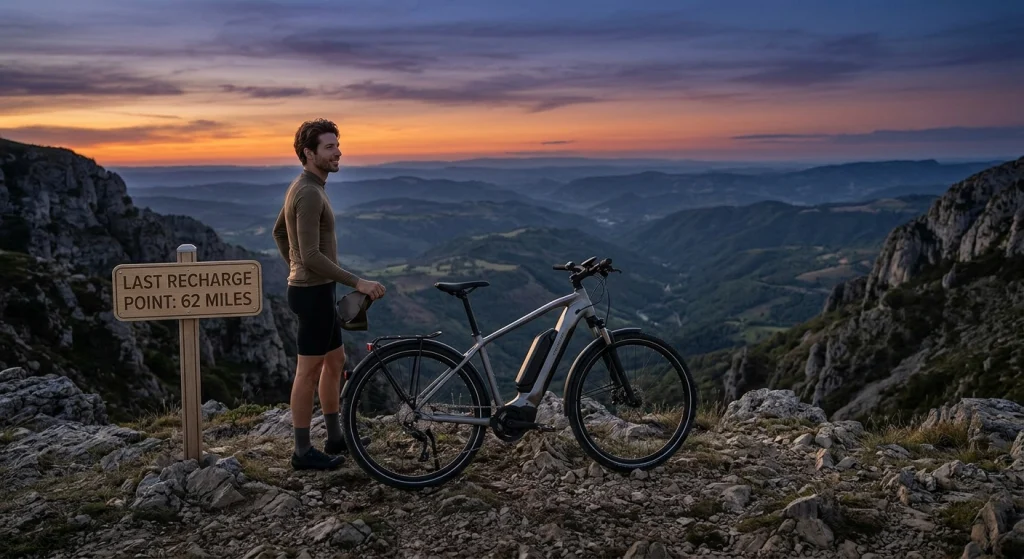
And on the battery-size question specifically, here’s the pattern I notice most: riders who buy the biggest battery “just in case” are usually the same ones who never see it drop below 60% on a normal week.
Meanwhile, the riders who actually need every one of those extra watt-hours already know it, because they’ve run a smaller battery dry more than once. If that’s never happened to you, it’s a pretty good sign 700Wh has you covered.
Who Actually Needs a 960Wh Battery
A bigger battery earns its keep for riders who fit one of these patterns:
- You haul cargo or carry a passenger regularly. Extra weight burns through watt-hours fast, and a bigger pack gives you a real buffer.
- Your rides involve real hills, not just gentle rolls. Climbing draws far more power than flat riding, and hilly commutes chew through a smaller battery quickly.
- You ride long distances between charging opportunities. Rural commuters, delivery riders, and touring cyclists without a mid-route outlet benefit the most.
- You’re a heavier rider who wants full-day range without babying the throttle. Weight is one of the biggest range factors there is, so the extra buffer matters more here than almost anywhere else.
- You genuinely hate charging often. Some riders would rather carry a bigger battery once than plug in every single night. That’s a valid reason on its own.
Who’s Overpaying for 960Wh They’ll Never Use
On the flip side, a lot of riders pay for range they’ll never touch. That’s probably you if:
- Your daily riding is under 20 miles round trip. Even at a fairly demanding pace, 700Wh covers that with plenty of room to spare.
- You ride mostly flat, paved routes. Without hills pulling extra power, your Wh-per-mile number stays low and your range stretches further than you’d expect.
- You charge at home or work every day anyway. If your battery never has to stretch across multiple days, a bigger tank just sits there unused most of the time.
- You’d rather have a lighter, easier bike to handle. If you’re carrying your e-bike up stairs or wrestling it into a tight storage spot, those extra pounds work against you daily for a range boost you rarely need.
- You’re working with a tighter budget. Every dollar spent on battery capacity you won’t use is a dollar not going toward brakes, tires, or a bike that fits you better overall.
700Wh or 960Wh? A Simple Way to Decide
If you’re still torn, ask yourself one question: have you ever actually run a smaller battery down to empty and wished you had more?
If the answer is no, or you’re not sure because you’ve never owned an e-bike before, 700Wh is very likely enough. It covers the vast majority of commutes, errands, and weekend rides with room to spare, and you’ll save weight and money in the process.
If the answer is yes, or you already know your rides involve hills, cargo, or long stretches without a charger, the extra weight and cost of 960Wh will earn its place fast. You won’t regret carrying a little more battery when you actually need it.
Either way, keep in mind that a dying battery isn’t always the end of the road mid-ride, and staying on top of a realistic maintenance routine will get more life out of whichever size you choose.
Frequently Asked Questions
What does Wh mean on an e-bike battery?
Wh stands for watt-hour, a measure of total energy storage. It’s calculated by multiplying the battery’s voltage by its amp-hours, and it’s the most accurate way to compare battery sizes across different bikes and brands.
How much farther will a 960Wh battery get me than a 700Wh battery?
About 37% farther under the exact same conditions, since that’s how much more energy it holds. In real miles, that usually works out to somewhere between 7 and 25 extra miles per charge, depending on your weight, terrain, and assist level.
Is a 960Wh battery worth the extra weight?
It depends on your rides. For hilly commutes, cargo hauling, or long-distance riding, yes, the range is worth the two to four extra pounds. For flat, short, everyday rides, most people won’t notice the extra range but will notice the extra weight.
How many watt-hours do I need for a 20-mile commute?
A 400 to 500Wh battery comfortably covers a 20-mile round trip for most riders under normal conditions. Both 700Wh and 960Wh leave you with a healthy buffer, so the choice comes down to how much reserve range you want on hand.
Does a bigger battery take longer to charge?
Yes, but not dramatically. A 700Wh battery typically takes 5 to 7 hours on a standard charger, while a 960Wh battery takes closer to 6 to 8 hours. Both charge fully overnight without any issue.
Final Thoughts
There’s no universal right answer between 700Wh and 960Wh. There’s only the right answer for how you actually ride.
Think honestly about your daily distance, your terrain, and how much weight you’re comfortable carrying, both on the bike and up your stairs.
Match the battery to that reality, not to the biggest number on the shelf, and you’ll end up with a bike that feels right every single time you ride it.