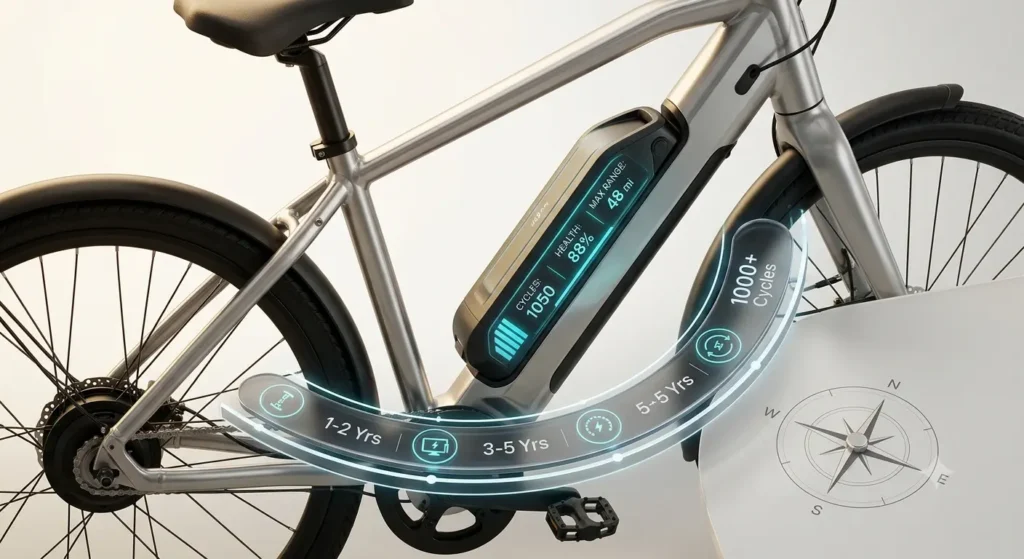
Your e-bike’s battery is like the heart of the bike: it powers you along on each ride. Naturally, most riders wonder “how long do ebike batteries last?” In simple terms, a good modern lithium-ion e-bike battery often keeps strong for several years. Most sources say 3–6 years of use before you notice much decline. In other words, think in the range of 500–1,000 full charge cycles before its capacity dips significantly. (A full cycle means charging from empty to 100% once.)
Why the range of 3–6 years? It depends on quality and care. High-end bikes with premium cells and smart electronics often reach 5–7 years in practice. Simpler or budget batteries might show wear closer to the 3–4 year mark, especially if they’ve been stressed (hot climate, heavy use, etc.). In any case, battery capacity always falls gradually—you won’t have it go dead overnight. Instead, it slowly gives you fewer miles per charge over time.
Charge Cycles vs. Calendar Age
It helps to separate useful cycles and calendar age. A charge cycle is basically using 100% of the battery’s energy. That can happen in one ride (from 0% to 100%) or spread out (two 50% charges = one cycle). Every cycle causes a tiny bit of wear. Most e-bike batteries are rated for several hundred cycles.
But even unused batteries age. Lithium cells have chemical processes that run in the background, so an old battery loses capacity over time (this is called calendar aging). Even sitting on a shelf, a pack will slowly fall. Experts note that no matter how well you care for it, a lithium battery will degrade year by year.
In fact, storing a battery fully charged or fully empty is bad: it stresses the chemistry. As one source points out, a battery left at 100% for months will age faster than one cycled lightly every week. So ideally you store batteries at about 40–60% charge if you’re not using them, and check them every few months.
In summary: both how much you ride (cycles) and how much time passes (calendar age) eat away at your battery’s peak energy.
Realistic Lifespan: Years and Miles
Putting it together, most riders find an e-bike battery serves well for 3–6 years of regular riding. For example, if you charge after each ride (say, riding every day), you might hit 500 cycles in about 2 years and 1,000 cycles in about 4 years. At that point, the battery is often around 70–80% of its original capacity. Beyond that age or cycle count, you’ll notice shorter ranges or slower charging.
What about miles? That depends on your bike and riding style. If your e-bike typically gets 25–35 miles per charge, then 500 cycles is on the order of 12,500–17,500 miles and 1,000 cycles about 25,000–35,000 miles. Of course, more leisurely riders who charge less often (or use less assist) might stretch that out. Conversely, someone doing hilly commutes every day might use more cycles or wear the battery down faster.
Keep in mind that battery makers usually warrant their packs for a couple of years or a few hundred cycles (e.g. 2 years/500 cycles for some Bosch packs). But with good habits, even after a warranty period the battery can often run well for much longer.
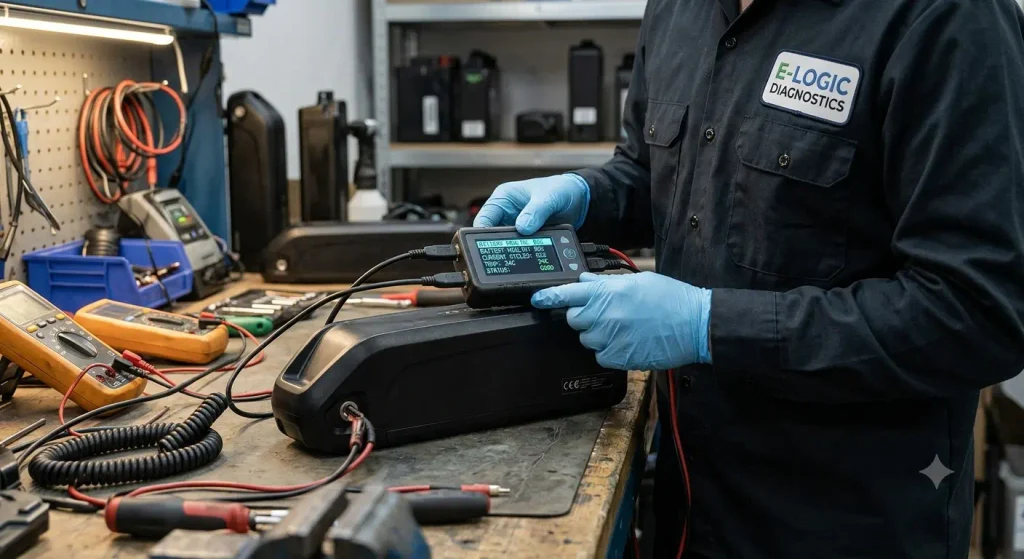
From the repair bench: We often see batteries starting to falter around the 3–5 year mark of normal use. By then (roughly 500–800 cycles), riders notice range drops or sluggish charge. At that point, a repair shop usually recommends replacement. In practice, a five-year-old battery on an active bike is likely worn down.
What Shortens E-Bike Battery Life?
Even with quality cells, certain habits and conditions will wear out a battery faster. The main culprits are:
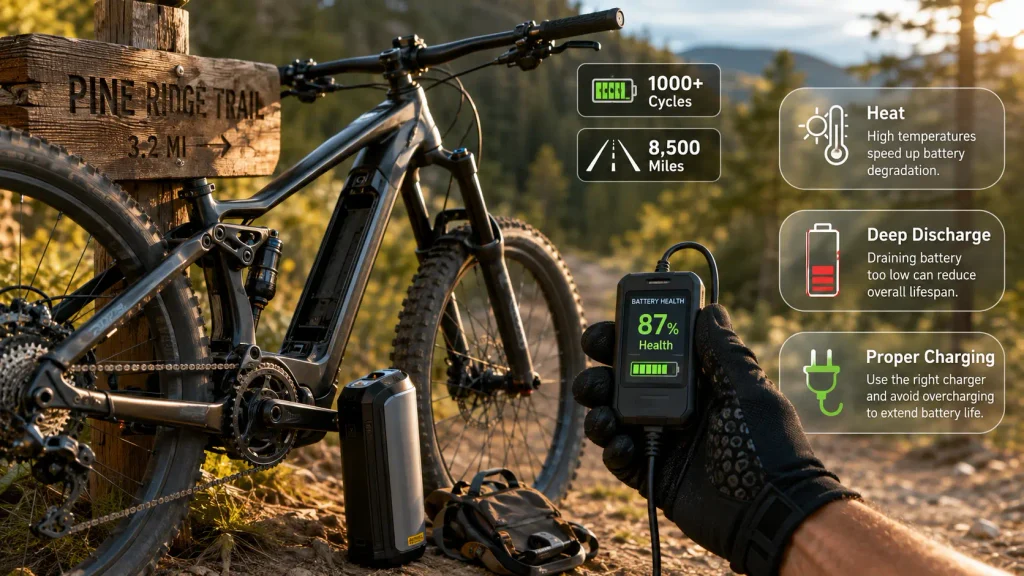
- Extremely high or low charge: Keeping the battery at 100% state of charge (like always charging to full and leaving it there) stresses the cells. Likewise, letting it drain completely (0%) frequently also hurts longevity.
- Extreme temperatures: Heat is the enemy. Leaving an e-bike in a hot car or direct sun can speed up chemical aging. Cold is less damaging long-term, but charging a cold battery can strain the cells. Essentially, if you can’t touch the battery case without it being too hot, that’s bad for it.
- Deep discharge spikes: Riding in maximum assist mode up steep hills constantly demands heavy current, generating extra heat. Over time, that speeds up degradation. In short, abusing the battery with constant heavy loads and stops/starts takes years off its life.
- Cheap or wrong chargers: Using a third-party or incorrect charger can deliver the wrong voltage or current. That not only risks immediate failure, it can also cause hidden stress to cells. Always use the charger designed for your bike’s battery.
None of these will instantly kill the battery, but they add up over time. A single mistake won’t ruin it, but repeatedly cooking the battery in the sun or letting it sit dead will.
How to Make Your Battery Last Longer
The good news is that simple habits greatly slow down aging. Follow these tips to maximize lifespan:
- Use proper charging range: Aim to keep the battery around 20–80% for day-to-day use. You don’t need to fully charge it after every ride. For example, if you only need 50% power for your commute, you could charge to 80% and then ride until 30%. This mid-range cycling is gentler on the battery.
- Avoid overnight overcharging: Even though modern chargers shut off when full, it’s best practice to unplug once charged. Use a timer if you must charge late at night. Only charge to 100% when you really need the extra range.
- Charge at normal temperature: Whenever possible, charge the battery at room temperature (say 50–70°F). If the battery is cold (like after riding in winter), let it warm up a bit before charging, or charge in a warm room. High-temperature charging (beyond ~95°F) should be avoided.
- Store it partially charged: If you park your bike for days or weeks, set the charge around 40–60% and keep it in a cool, dry place. Avoid leaving it at 0% or 100% for long storage. This is a common recommendation for all lithium batteries and slows calendar aging.
- Use the original charger: The charger that came with your bike is designed for its battery chemistry and safety specs. Using an aftermarket or mismatched charger can reduce lifespan or even cause failure. If your charger breaks, replace it with an approved one.
- Ride regularly: Batteries prefer some use. Very long periods without use let voltages drift and can trigger protective cutoffs. If you store the bike for months, check the battery once a month and top it up slightly.
Following these habits doesn’t mean your battery will last forever, but it makes a big difference in practice. In one study, charging between 25–75% instead of 50–100% roughly doubled the number of cycles achievable for a given amount of wear. In other words, small changes add up over the years.
When to Replace Your Battery
Every battery eventually wears out. You’ll know it’s time for a new one when normal rides suddenly feel short on power or the pack misbehaves. Key signs are:
- Dramatic range loss: If your bike used to go 60 km on a charge and now only reaches 40 km under the same conditions, the cells have aged (capacity is below ~70%).
- Long charging times: If it used to charge in 3 hours and now takes 1–2 extra hours or never reaches 100%, internal resistance has increased.
- Cut-offs or power drops: If the bike shuts off under load or the battery drops voltage quickly (even though it’s showing charge left), that indicates weak cells.
- Visible damage or swelling: Any bulging, leaks, or burnt smells require immediate battery replacement.
As a rule of thumb, many shops consider a battery “worn out” by 3–5 years (or ~500+ cycles). At that stage, even with good care you’ll lose a noticeable chunk of capacity. Swapping in a new battery restores your range. When replacing, choose a compatible pack with good-quality cells to get another few years of service.
Frequently Asked Questions
How long do ebike batteries last in years?
Most modern e-bike batteries last about 3–6 years with normal use. High-quality packs often stretch to 5–7 years if treated well.
How many charge cycles can an e-bike battery handle?
A typical lithium e-bike battery endures around 500–1,000 full charge cycles before its capacity drops significantly. (Doing two 50% charges counts as one full cycle.)
What shortens an e-bike battery’s life the most?
Major culprits are extreme temperatures, deep discharges, and staying at 100% (or 0%) charge for long periods. Also, using the wrong (non-OEM) charger or overtaxing the battery with heavy loads speeds up aging.
How can I extend my e-bike battery’s lifespan?
Follow best practices: charge and store the battery in cool conditions, keep it in the mid-range (~20–80% charge) for everyday use, avoid leaving it at 100% or 0%, and always use the original (correct) charger. Frequent gentle top-ups are better than regular deep drains.
When should I replace my e-bike battery?
If you notice a noticeable drop in range (e.g. you used to get 40 miles, now it’s 25) or the battery struggles to hold a full charge after about 3–5 years/500+ cycles, it’s time to think about replacement. Swelling or erratic power are also warning signs.
Final Thoughts
So, how long will your e-bike battery last? In most cases, expect several hundred charge cycles or a few years of regular use.
By following good charging and storage habits, you can stretch that lifespan out. Avoid the extreme states, keep it cool, and check on it now and then.
When the time comes, replacing the battery is usually simpler and cheaper than buying a whole new bike. With reasonable care, your pack should give you many good miles of riding enjoyment.