Shopping for an e-bike means staring down a wall of numbers. Watts. Volts. Amp-hours. It’s a lot to take in when all you really want is a bike that gets you up the street without wheezing.
One question trips up almost every new buyer: should you get a 36V e-bike or a 48V one?
Let’s get 36V vs 48V ebike voltage explained the simple way, no engineering degree needed. By the end of this guide, you’ll know exactly which one fits your rides.
Quick answer
Most riders do best with 48V. Casual, flat-road riders can save money and weight with 36V.
If you stick to flat streets, bike paths, or short trips around town, a 36V e-bike gives you plenty of power. It’s lighter, usually cheaper, and simple to live with. If you climb hills often, carry cargo, ride with a passenger, or just want a stronger throttle punch, 48V is the better fit.
- 36V: Light, efficient, and easy on your wallet
- 48V: Stronger, quicker to respond, and built for tougher terrain
What Does 36V or 48V Actually Mean?
A volt measures electrical pressure. It’s how hard your battery pushes power toward the motor.
Think of it like water in a hose. Voltage is the water pressure. Amps are how much water is flowing. Multiply the two together, volts times amps, and you get watts. That’s the actual power hitting your motor.
That’s the part a lot of guides skip. Voltage alone doesn’t tell you how powerful a motor is. It tells you how much pressure is available to work with.
36V systems
- Moderate pressure
- Lighter battery pack
- Common on budget and entry-level e-bikes, plus many folding models
- Great for flat rides and short commutes
48V systems
- Higher pressure
- More headroom for power
- Common on mid-range and performance e-bikes
- Better for hills, cargo, and stronger acceleration
You’ll also spot 24V on some older scooters and small mobility devices. It’s the low rung of the ladder, and today it’s mostly saved for smaller builds rather than full-size e-bikes. On the other end, you’ll sometimes see 52V or even 72V on performance and off-road machines, but for most people cross-shopping regular commuter and city e-bikes, the real decision comes down to 36V vs 48V ebike setups.
Higher voltage generally means quicker throttle response, better hill climbing, and more headroom before the motor strains. But it also usually means a heavier, pricier battery. Bigger isn’t automatically better. It’s about matching the system to how you actually ride.
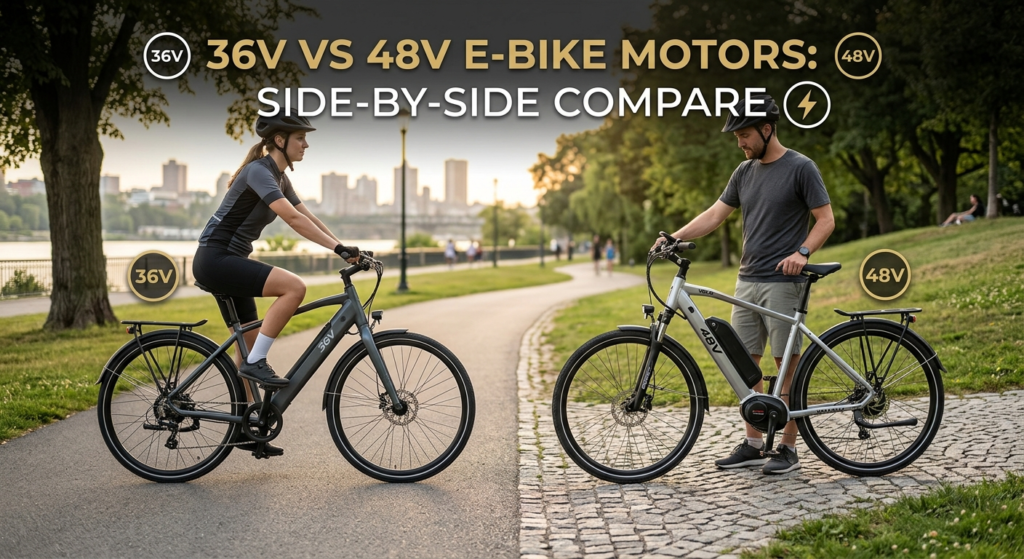
36V vs 48V E-Bike: Side-by-Side
| Feature | 36V E-bike | 48V E-bike |
| Best for | Flat commuting, short trips | Hills, cargo, longer rides |
| Typical top speed | 15–20 mph | 20–28 mph |
| Acceleration | Moderate | Strong |
| Hill climbing | Fair to good | Very good to excellent |
| Range (same battery size) | Similar; steady on flat ground | Similar; slight edge under heavy load |
| Battery weight | Usually lighter | Usually heavier |
| Common motor pairing | 250W–500W | 500W–750W |
| Price | Lower | Higher |
| Urban commuting | Excellent | Very good |
| Off-road riding | Fair | Good to excellent |
| Steep hills | Fair | Excellent |
| Legal status (U.S.) | Widely legal | Widely legal, check local wattage rules |
Voltage vs. Wattage: Why These Aren’t the Same Thing
People mix these up all the time. It’s an easy mistake to make.
Wattage tells you how much total power a motor can use. Voltage tells you how much electrical pressure is available to make that power happen. Here’s the part that surprises people: two e-bikes can both be rated at 500 watts, and one runs on 36V while the other runs on 48V. What’s different is the amps.
Watts equal volts times amps. So a 36V bike hitting 500W is pulling around 14 amps. A 48V bike hitting that same 500W only pulls about 10 amps. Lower amps usually means less heat and less strain on the wiring, plus a bit more headroom before the system starts working hard. That’s part of why a 48V bike often feels smoother when the road tilts up, even at a similar wattage rating.
If you want the deeper breakdown of what wattage does on its own, the difference between a 500W and 750W motor is worth a look too. Voltage and wattage work together, but they aren’t doing the same job.
Power and Speed: What You’ll Actually Feel
36V feels like a steady push
It’s good for cruising. Easy to manage. Predictable off the line.
48V feels like a stronger shove
It launches harder from a stop and holds speed better against wind or a slight incline.
| Voltage | Typical assisted speed* |
| 36V | 15–20 mph |
| 48V | 20–28 mph |
*Actual speed depends on motor wattage, controller tuning, tire size, rider weight, and local speed limits, not voltage alone.
Most e-bikes sold in the U.S. are speed-limited anyway, so the real-world gap is often smaller than the spec sheet suggests. If you’re curious how far a bike can legally push it, some models are built to hit 28 mph right out of the box.
Best E-Bike Voltage for Hills: Where the Difference Really Shows Up
If you live somewhere hilly, this is the section that matters most.
Torque, not voltage, is technically what muscles you up a hill. But voltage plays a big supporting role. It’s the pressure that lets the controller push more current into the motor without straining the system.
On a steady, moderate climb, a 36V e-bike usually manages fine. You might feel it slow down and work hard, especially near the top. A 48V e-bike handles the same hill with more headroom. It holds speed better, and the motor doesn’t have to work as close to its limit.
Example: a 10% grade hill with a loaded pannier bag
- 36V: Noticeable slowdown, more pedaling needed near the top
- 48V: Steadier climb, less pedaling effort required
Which e-bikes actually deliver the most torque is worth a look if hills are your main concern. A strong motor paired with a 48V system is usually the winning combination for steep grades.
Range and Battery Life: The Real Story
Nobody wants to run out of juice halfway home, and this is where a lot of buying guides get it wrong.
Voltage by itself doesn’t determine range. Total energy does, measured in watt-hours. You get that number by multiplying voltage by amp-hours. A 36V battery rated at 15Ah and a 48V battery rated at 11Ah both land around 540Wh. Same fuel tank, different voltage.
So don’t assume a 36V bike automatically goes farther, or that 48V automatically drains faster. What matters is the size of the battery, not just the volt number on the label.
Where voltage does make a small difference is efficiency under load. A 48V system pulls fewer amps to make the same power, which means less energy wasted as heat in the wires and controller. On steep hills or with heavy throttle use, that can add up to slightly better real-world range compared to a 36V system working just as hard.
If you’re comparing battery sizes rather than voltage, 700Wh and 960Wh batteries are a good next stop. That number matters more for range than the volt rating does.
Weight and Handling
36V advantages
- Usually a lighter battery pack
- Easier to carry up stairs or load onto a rack
- Feels closer to a regular bicycle
48V trade-offs
- Often a heavier pack
- More stable at higher speeds
- Worth the extra pounds if you’re hauling cargo
From the Repair Bench
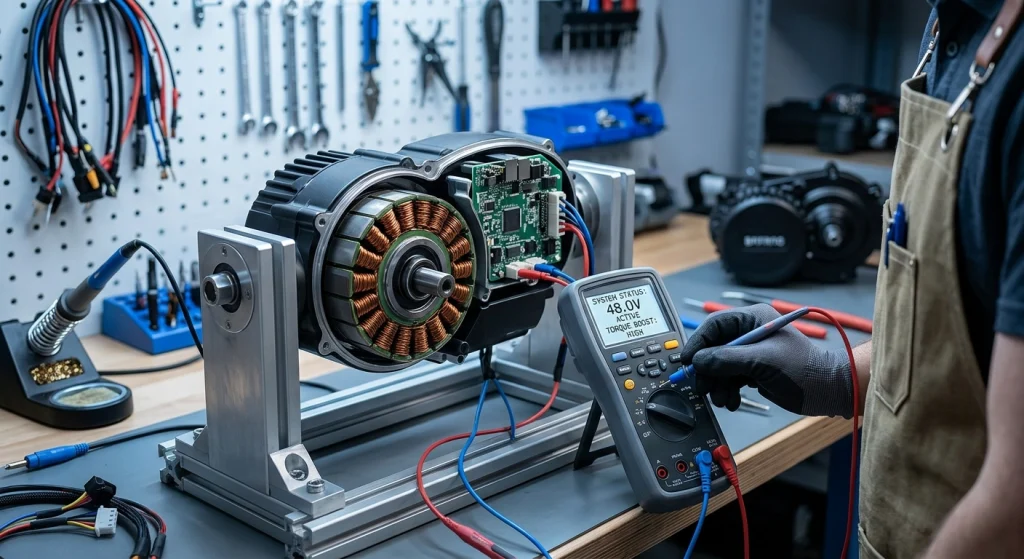
I spent nine years rebuilding hub motors and doing e-bike conversions before I ever wrote a buying guide, and the voltage question came up in the shop more than almost anything else.
The bikes I saw fail the most weren’t broken because 36V or 48V was the “wrong” choice. They failed because someone swapped in a bigger battery without checking if the controller and motor could handle the jump. A 36V hub motor pushed by a 48V pack runs hot, and hot windings don’t last. I rewound more than one motor that told that exact story.
My rule in the shop was simple: match your battery, controller, and charger to what the bike was built for. If you want more power, upgrade the whole system, not just the piece that looks easiest to swap.
Can You Just Upgrade a 36V E-Bike to 48V?
Technically, sometimes. Practically, it’s rarely as simple as swapping the battery.
Your motor, controller, display, and charger are all built around a voltage range. Push a 48V battery into a system designed for 36V, and you risk overheating the motor, frying the controller, or damaging the display. If you’re set on more power, the safer move is upgrading the whole system together, not just one part. Modifying an e-bike controller is possible, but it’s not a weekend project for most riders, and it can void your warranty fast.
Mismatched chargers carry their own risk. Using a 36V charger on a 48V pack, or the other way around, isn’t just bad for the battery. It’s a real fire hazard. Battery fires on e-bikes are rare, but they almost always trace back to a mismatch like this somewhere in the system.
If your current bike feels underpowered, it’s usually cheaper and safer to sell it and buy a bike built around the voltage you actually want.
Legal Limits and Why Voltage Isn’t the Deciding Factor
Here’s something that surprises a lot of buyers: U.S. e-bike laws don’t actually regulate voltage. They regulate wattage and speed.
Most states follow the three-class system:
- Class 1: Pedal assist only, up to 20 mph
- Class 2: Throttle assisted, up to 20 mph
- Class 3: Pedal assist, up to 28 mph
Motors are generally capped at 750W to count as a bicycle instead of a moped. Voltage isn’t part of that formula. It’s just one of the tools that gets a motor to its wattage number.
That said, rules vary by state, and some are getting stricter about battery certification and fire safety. Battery laws have been changing fast, state by state, so it’s worth checking your local rules before you buy or upgrade anything. And if you’re tempted to unlock extra speed, know that removing a speed limiter usually pushes a bike out of its legal class. That can affect insurance, trail access, and warranty coverage.
Cost: Is 48V Worth the Extra Money?
36V: budget-friendly
- Lower purchase price, often starting around $700–$1,200
- Lighter, cheaper replacement batteries
- Lower cost to charge and maintain over time
48V: higher upfront cost
- Purchase price often starts around $1,000–$2,000+
- Batteries cost more to replace
- Usually paired with stronger brakes and drivetrain parts
Simple rule: if a 36V bike covers your rides comfortably, don’t pay extra for 48V. If hills or cargo are a regular part of your life, 48V often pays for itself in a smoother ride.
Common Myths About 36V and 48V
Myth 1: 48V is always faster.
Not necessarily. Most e-bikes are speed-limited by software regardless of voltage. The real-world gap in top speed is often just a few mph.
Myth 2: 36V can’t handle hills at all.
Not true. A well-built 36V motor with good torque handles moderate hills just fine. It’s steep, sustained climbs where it starts to strain.
Myth 3: Higher voltage always means less range.
Range depends on total watt-hours, not voltage. A big 36V battery can easily outlast a small 48V one.
Myth 4: You can safely mix voltage components.
Never assume this. Batteries, controllers, motors, and chargers need to match. Mixing them is the fastest way to damage, or a dangerous result.
Who Should Buy a 36V E-Bike?
Choose 36V if most of these sound like you:
- You ride mostly flat or gently rolling roads
- Your trips are under 10–12 miles each way
- You want the lightest bike possible
- You’re watching your budget
- You don’t carry heavy cargo
Best fit: City commuters, casual riders, and anyone who wants a simple, lightweight e-bike.
Who Should Buy a 48V E-Bike?
Choose 48V if most of these sound like you:
- You live somewhere hilly
- You carry cargo, groceries, or a passenger
- You rely on the throttle often
- You want stronger acceleration
- You ride longer distances or mixed terrain
Best fit: Hilly-neighborhood riders, cargo-bike owners, and anyone who wants the strongest all-around performance.
A Simple Decision Tree
Step 1: Is your route mostly flat?
Yes → 36V is probably enough.
No → go to Step 2.
Step 2: Do you climb real hills regularly?
Yes → 48V is worth it.
No → go to Step 3.
Step 3: Do you carry cargo or lean on the throttle a lot?
Yes → 48V.
No → 36V.
Real-World Examples
- Flat-city commuter: 150 lbs, six-mile commute, mostly bike lanes. Best choice: 36V. Light, efficient, and plenty strong for the ride.
- Hilly-neighborhood rider: 190 lbs, steep streets, daily climbs. Best choice: 48V. The extra pressure makes climbs feel manageable instead of exhausting.
- Weekend cargo hauler: Groceries and a kid’s trailer most weekends. Best choice: 48V. It handles the extra load without straining the motor.
Frequently Asked Questions
Is 48V much faster than 36V?
Not usually. Most e-bikes are speed-limited either way. The bigger difference is how quickly the bike gets up to speed and holds it on hills.
Does 36V give better range than 48V?
Not automatically. Range depends on total watt-hours, not voltage alone. Compare battery capacity, not just the volt number.
Can I put a 48V battery on a 36V e-bike?
Not safely, in most cases. The controller and motor need to match the voltage, or you risk overheating and damage.
Which voltage is better for hills?
48V generally handles hills better. It gives the motor more headroom before it starts to strain.
Is 48V worth the extra cost for a beginner?
Only if you need the power. Most new riders do just fine on 36V unless hills or cargo are part of daily riding.
Final Verdict
Still not sure? Go with 48V if your budget allows it. It gives you more room to grow into, especially if your riding needs change down the road.
Choose 36V if you want the lightest, most affordable option for flat routes and short commutes.
Choose 48V if hills, cargo, or stronger acceleration are part of your regular ride. One-sentence summary: 36V keeps things light and simple, while 48V gives you the power to handle whatever the road throws at you.