A good used e-bike can save you hundreds of dollars, sometimes more, compared to buying new.
A bad one can turn into a money pit fast, especially once you factor in the cost of a replacement battery.
The good news is you don’t need to be a bike mechanic to tell the difference. You just need to know where to look and what to look for when buying a second hand electric bike. Grab a coffee, and let’s walk through it.
Why Buying a Used E-Bike Can Be a Smart Move
E-bikes lose value fast in the first year or two, the same way cars do. A bike that cost $2,500 new might sell for $1,200 to $1,800 just a year or two later, even if it’s barely been ridden. Buying used also keeps a perfectly good bike out of a landfill, which matters if that’s something you care about.
The tradeoff is you’re taking on some risk the original buyer already covered: the warranty, the peace of mind that everything actually works, and the unknown history of how the bike was treated. That’s exactly what the rest of this guide helps you sort out.
Know What You Need Before You Start Looking
Before you start scrolling listings, picture how you’ll actually use this bike. Commuting on pavement? Hauling groceries? Hitting dirt trails on weekends? Your answer narrows the search a lot, because a used commuter e-bike and a used electric mountain bike get checked out very differently.
If you’re still torn between new and used, our breakdown of what to look for when buying an electric bike covers the new-bike side of that decision and is worth a quick read before you commit to the used market.

The Battery: The Most Important Thing to Check
The battery is the single most expensive part of any e-bike, often 30 to 40% of what the whole bike cost new. It’s also the one part that wears out no matter how careful the previous owner was.
Every lithium-ion battery has a limited number of charge cycles before its capacity starts dropping for good, usually somewhere between 500 and 1,000 full cycles before it dips below 80% of its original range. Our guide on how many times you can charge an electric bike battery breaks down exactly how that number adds up, but the short version is this: an older battery isn’t dead, it just won’t go as far as it used to.
Ask the seller directly:
- How old is the battery, and is it the original one?
- How many miles or charge cycles does the display show?
- How far does it go on a full charge now, compared to when it was new?
If the bike has a display or app that tracks mileage and battery health, ask to see it before you buy.
Motor and Drive System: Hub vs. Mid-Drive
You’ll find one of two motor types on any e-bike. A hub motor sits inside the wheel and pushes it directly. It’s simple, quiet, and usually cheaper to repair. A mid-drive motor sits at the pedals and uses the bike’s own gears, which feels more natural and climbs hills better.
Neither one is automatically better, but a few things matter more on a used bike than a new one. Stick to recognizable motor brands like Bosch, Shimano, Brose, or Yamaha, since replacement parts and qualified repair shops are much easier to find. A bike built around an off-brand motor might be fine, but if it ever needs work, you could get stuck. Torque, not just wattage, tells you how strong that hill-climbing push really feels, and our guide on which e-bike has the most torque explains why that number matters more than flashy wattage claims.
Look at the motor casing for scratches around the screws, which can mean it’s been opened before, or dents that suggest a hard fall.
Give the Bike a Full Physical Checkup
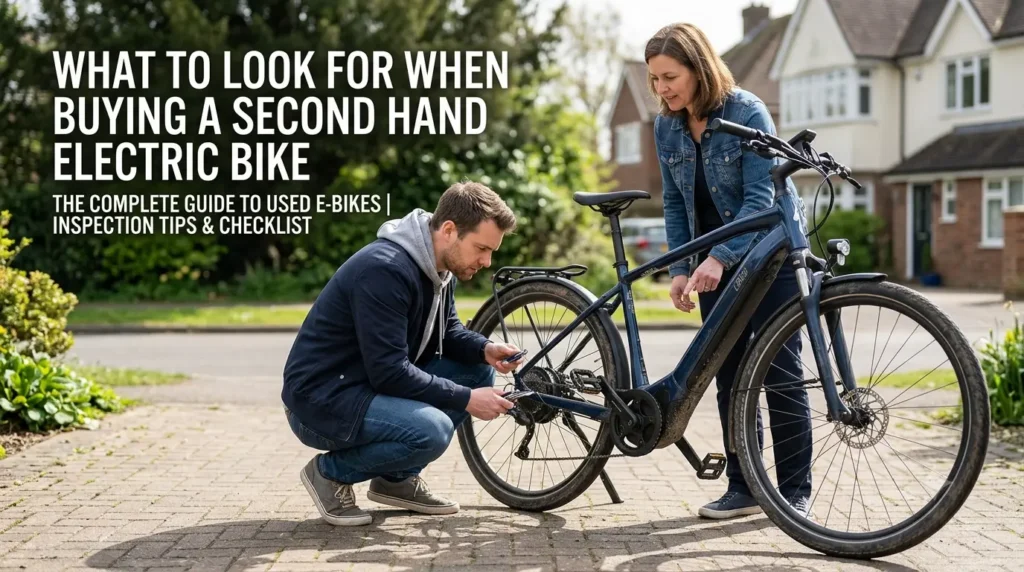
Once the electronics check out, look the bike over the way you would any used bicycle.
- Frame: Run your hand along the welds, especially near the head tube and bottom bracket. Cracks, deep dents, or fresh paint patches covering rust are all reasons to slow down. A cracked frame isn’t repairable. It’s a safety issue, full stop.
- Drivetrain: Look at the teeth on the chainring and cassette. Worn teeth look hooked or shark-finned instead of straight. A rusty chain is a cheap fix. A stretched chain paired with a worn cassette is pricier.
- Brakes: Squeeze the levers. They should feel firm, not spongy. Check the pad thickness, and budget for a quick replacement if there’s barely anything left.
- Tires and wheels: Spin each wheel and watch for wobble. Check tread depth, and look for dry cracking, which means the tires have been sitting in the sun a long time.
- Wiring and connectors: Look for taped-up wiring, mismatched connectors, or a battery that doesn’t sit flush in its mount. Home-brew electrical fixes are a bigger warning sign on an e-bike than they’d be on a regular bicycle.
Fit matters here too, just like with any bike. The same height-and-inseam approach used for the right mountain bike size applies to e-bikes, so it’s worth measuring yourself rather than guessing from a size label.
Take It for a Real Test Ride
Specs and photos can’t tell you how a bike actually feels. Ride it for 15 to 20 minutes if the seller allows it, ideally somewhere with a small hill.
Pay attention to whether the motor kicks in smoothly or with a jolt, and whether pedal assist feels consistent across its levels. Our guide to how much assistance an e-bike actually gives explains what each assist level is supposed to feel like, which is handy context before you ride. Also listen for grinding or rattling, check that the brakes stop you confidently, and watch whether the battery indicator drops faster than it should for such a short ride.
If a seller won’t let you test ride the bike at all, that’s worth noticing.

Make Sure the Bike Isn’t Stolen
This part feels uncomfortable to bring up, but it matters. E-bikes are a common theft target because they hold their resale value so well.
Ask for the original receipt or proof of purchase. A seller who can’t produce one, or gets vague about where they bought it, is a red flag. You can also check the bike’s serial number, usually stamped under the bottom bracket, against bike theft registries before paying anything. It takes a couple of minutes and can save you from buying a bike that gets reclaimed by its real owner later.
Questions to Ask the Seller
A few direct questions tell you a lot fast:
- How many miles are on it, and how long have you owned it?
- Are you the original owner?
- Why are you selling it?
- Has it had any repairs, recalls, or motor or battery replacements?
- Does it come with the original charger and both keys?
Hesitation or vague answers to simple questions usually tell you more than the answers themselves.
What’s a Fair Price?
As a rough rule of thumb, a used e-bike in good condition typically sells for 40% to 70% of its original retail price, depending on age, mileage, and battery health. A two-year-old bike with a healthy battery and light wear might land near the top of that range. A four-year-old bike with a tired battery should land much closer to the bottom, or you should factor a battery replacement into your offer.
It helps to know what the bike cost new in the first place. Our breakdown of the average cost of an electric bike gives you typical retail pricing by category, which makes it much easier to judge whether a used asking price is actually a deal.
Where to Buy: Private Seller, Local Shop, or Certified Marketplace
Each option trades price for risk a little differently.
- Private sellers (Craigslist, Facebook Marketplace, local groups) often have the lowest prices, but you’re on your own for inspection with no recourse if something’s wrong after you pay. Meet in a public place, and never send money before seeing the bike in person.
- Local bike shops sometimes sell trade-ins or demo models. You’ll pay a bit more, but the bike has likely been inspected and tuned, and there’s someone to call if something goes wrong.
- Certified used e-bike marketplaces inspect, refurbish, and often warranty what they sell. You’ll pay the most of the three, but it’s the lowest-risk path if you’re not confident doing your own inspection.
What You Lose When You Buy Used: Warranty
Here’s something a lot of first-time used buyers miss: most e-bike warranties only cover the original purchaser and don’t transfer with a sale. If the motor or battery fails a month after you buy it, you’re paying full price for the fix unless the seller is a shop or marketplace offering its own coverage.
That’s not a reason to skip buying used. It’s a reason to factor the missing warranty into your offer, and to lean toward sellers who reduce that risk, whether that’s a shop, a certified marketplace, or a careful private owner with service records to back up their story.
Red Flags That Mean You Should Walk Away
A few warning signs show up again and again in bad used e-bike deals:
- No proof of ownership or original receipt
- Missing charger or keys, with an offer to “knock off some money” instead
- The seller won’t allow a test ride or a mechanic’s inspection
- Taped, modified, or non-standard wiring and chargers
- A price that feels too good to be true for the model and condition
- Vague or inconsistent answers about mileage, history, or why they’re selling
One of these alone might have an innocent explanation. Two or more together is usually a sign to keep looking.
A Few More Things Worth Checking
How was it stored?
A bike that’s spent winters outside in freezing temperatures is more likely to have battery and seal issues than one kept indoors. Our guide on whether you can leave an electric bike outside in winter explains exactly what cold exposure does to a battery over time, which is useful context when you’re asking a seller about storage habits.
Has anything been modified?
If the bike has a conversion kit, aftermarket battery, or non-original motor, check whether that setup is even legal where you live before buying. Our guide to electric bike conversion kit laws covers the power and speed limits that vary by state and country.
Is now a good time to buy?
Prices on used e-bikes tend to soften in late fall and winter when fewer people are shopping, a pattern similar to what we cover in our guide to the best time to buy an e-bike. If you can be patient, timing your purchase can save you more than any single negotiating tactic.
Frequently Asked Questions
How much should I pay for a used e-bike?
Most used e-bikes in good condition sell for 40% to 70% of their original retail price. Older bikes or ones with a tired battery should cost less, since you’ll likely need to replace the battery soon.
How do I know if a used e-bike’s battery is still good?
Ask for the charge cycle count or battery age, and check the real-world range on a test ride. A battery holding above 80% of its original capacity is generally considered healthy.
Do e-bike warranties transfer to a new owner?
Usually not. Most manufacturer warranties only cover the original buyer, so factor that into your offer, or buy from a shop or marketplace that offers its own coverage.
Is it safe to buy a used e-bike from a private seller?
It can be, as long as you check proof of ownership, inspect the bike in person, test ride it, and meet somewhere public. Certified marketplaces and shops carry less risk but usually cost more.
How can I tell if a used e-bike is stolen?
Ask for the original receipt, check the serial number against bike theft registries, and be cautious of sellers who can’t explain where or when they bought the bike.
The Bottom Line
A used e-bike can be one of the best deals in cycling right now, but only if you do a little homework first. Check the battery, look the bike over carefully, take it for a real ride, and ask the seller a few direct questions. Most honest sellers won’t mind any of that, and if someone does mind, that tells you something too.