Key Takeaways:
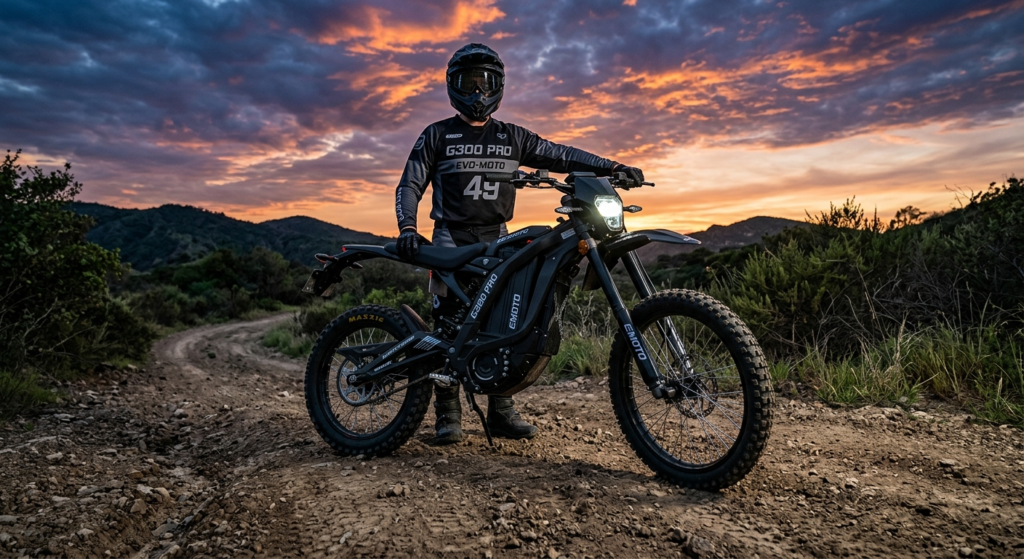
- The HAPPYRUN G300 Pro: is the best overall pick for most buyers — best load capacity in this price range, strong 72V battery system, and a US-based brand with actual dealer support. If you want mid-drive torque for technical trail riding.
- The Freego N5: is the upgrade. If budget is the priority and you’re under 200 lbs.
- The COSWHEEL R6000: competes on value.
A men’s electric bike for adults 50 mph isn’t really a bicycle in the legal or mechanical sense. These machines have more in common with electric dirt bikes and small electric motorcycles than with the e-bikes at your local shop.
They run on 60V–72V electrical systems with motors peaking at 6,000–8,000W. They hit 50+ mph in their top speed mode. The pedals are technically there — which is how some brands market them as “e-bikes” — but at these speeds and power levels, you’re not pedaling. You’re riding.
That distinction matters enormously before you spend $2,000–$3,000. These machines are built for private land, off-road trails, and closed-course riding. They are not street-legal as electric bikes in most US states. That’s not a knock on the product — it’s the legal reality this category lives in, and most competing articles gloss over it in a single sentence. We’re going to be more useful than that.
If you have land to ride on, access to an off-road park, or a clear plan for registration as a motor vehicle — this category genuinely delivers. The three best options on Amazon are real performers. Here’s what you need to know to pick the right one.
Who should buy a 50 mph electric bike:
- Riders with private land, farms, or large rural properties
- Off-road park and closed-trail riders where high-powered electrics are welcome
- Experienced motorbike or dirt bike riders transitioning to electric
- Buyers planning to register the bike as a motor vehicle for public road use
Who should not buy a 50 mph electric bike:
- Commuters expecting to ride legally in bike lanes
- Beginners with no prior dirt bike or motorbike experience
- Anyone without dedicated off-road riding space
- Buyers expecting 70 miles of range while riding at 50 mph (that’s not how battery physics works)
Biggest strength: Motorcycle-level power at sub-$3,000 pricing
Biggest weakness: Not street-legal as a bicycle in most US states
Best use case: Private off-road riding — land, farms, trail systems, closed courses
Overall value: Strong. Comparable electric motorcycle performance from established brands costs two to three times more.
| Spec | HAPPYRUN G300 Pro | Freego N5 | COSWHEEL R6000 |
| Peak Motor Power | 6,500W | 8,000W | 7,000W |
| System Voltage | 72V | 72V | 60V |
| Battery Capacity | 2,160Wh (30Ah) | 2,880Wh (40Ah) | 1,800Wh (30Ah) |
| Top Speed | 50 mph | 53 mph | 55 mph |
| Motor Type | Rear hub | Mid-drive | Rear hub |
| Torque | 245N.m | 380 N·m | 180 N·m |
| Front Suspension | Adjustable fork | 210mm hydraulic | 180 mm front |
| Brakes | Hydraulic disc | 4-piston hydraulic | Hydraulic dual-piston |
| Load Capacity | 350 lbs | 264 lbs | 150 Kg |
| Claimed Range | 70 miles | 40–70 mi | 56–80 mi |
| Safety Cert | — | — | UL 2849 |
| Amazon Price | $1,899 | $3,699.99 | $1,599.99 |
| Purchase Link | Buy Here | Buy Here | Buy Here |
What Is a Men’s Electric Bike for Adults 50 MPH?
It’s a high-powered electric off-road machine — the gap between an e-bike and an electric motorcycle.
A standard Class 3 e-bike caps out at 28 mph with a 750W motor and a battery in the 500–750Wh range. What you’re looking at here is completely different. These bikes run motors rated at thousands of watts with battery packs that dwarf anything on a commuter e-bike. They look like electric dirt bikes. They ride like electric dirt bikes. The pedals are present in a regulatory sense, not a practical one.
That’s not a criticism. It’s what makes them compelling. You get genuine off-road capability, motorcycle-level acceleration, and a top speed that makes trail riding or farm work genuinely fast — all from an electric machine that costs a fraction of what a specialist electric motorcycle runs.
What you give up is street legality under the standard e-bike classification system, which stops at 28 mph and 750W. If you need something that’s legal on bike paths and public lanes without additional registration, a quality Class 3 e-bike is the right conversation
The Legal Reality Most Articles Underexplain
Other guides say “check your local laws” and move on. That’s not enough if you’re spending $2,500.
Under US federal consumer product law, an electric bike is defined by three criteria: operable pedals, motor rated at 750W or less, and maximum speed of 20 mph under motor power alone. States layer their own rules on top, with the most common framework being three classes — Class 3 being the fastest at 28 mph.
A 6,500W motor that does 50 mph doesn’t fit any of those classes. Legally, depending on your state, it’s a moped, motor-driven cycle, or off-road motor vehicle. That has real implications:
- You cannot legally ride it on public bike paths or multi-use trails as an “electric bicycle”
- Public road use typically requires registration and insurance
- Some states require a motorcycle license or endorsement
- Operating without proper classification on public roads can result in fines or impoundment
On private property — a farm, large lot, private trail, closed off-road course — this usually doesn’t apply. Most buyers in this category use these bikes exactly as intended: off-road, on land they control or have access to. That’s a completely valid and legal use case.
Some manufacturers provide a Certificate of Origin that allows buyers to register these bikes as mopeds or motor-driven cycles in certain states. COSWHEEL explicitly offers this. If street-legal public road riding is your goal, ask the manufacturer directly about the registration documentation process for your state before buying.
Key Features That Actually Matter
Motor Type: Hub vs. Mid-Drive
The HAPPYRUN G300 Pro and COSWHEEL R6000 use rear hub motors — the motor sits inside the rear wheel hub. The Freego N5 uses a mid-drive — the motor sits at the crankset and works with the bike’s gear system.
For open-land riding and flat-to-rolling terrain, hub motors are simpler, more reliable, and perfectly capable. For technical off-road trails with significant climbing, a mid-drive’s ability to multiply torque through the gear system gives it a real advantage on sustained steep grades. The tradeoff is complexity — mid-drives have more moving parts interacting with the drivetrain, which means more maintenance and more potential points of failure.
Choose hub if you’re doing general off-road riding and want simpler long-term maintenance. Choose mid-drive if you’re regularly climbing serious grades on technical terrain.
Peak vs. Continuous Motor Power
A “6,500W motor” means 6,500W is the peak output during maximum load bursts. The motor’s continuous rating — what it sustains over time without heat issues — is typically much lower. On the G300 Pro, that’s around 3,000W continuous. Any brand that only advertises peak numbers without stating continuous output is hiding information worth knowing. Peak power governs acceleration and short climbs. Continuous power governs how the motor handles sustained load without getting into thermal protection.
Battery Voltage and Capacity
Higher voltage systems (72V vs. 60V) generally produce more responsive throttle feel and better high-speed efficiency. Think of it like water pressure — more voltage pushes current through the system more forcefully. All else equal, a 72V system will feel more alive than a 60V system at the same claimed wattage.
Capacity in watt-hours (Wh) tells you the actual energy stored. A 72V 30Ah battery = 2,160Wh. That’s what you’re burning through when you ride. More Wh means more potential range, but only if you’re not burning it at full throttle. Understanding your e-bike battery’s capacity and cell quality is one of the most important factors in real-world ownership — it’s where cheap bikes cut corners.
Suspension Quality
At 50 mph on uneven terrain, suspension is safety equipment, not a comfort feature. Look for inverted (upside-down) front forks — they’re stiffer and better sealed than conventional right-side-up forks. Travel matters: 150mm is a starting point, 180mm+ is appropriate for serious off-road use. Rear suspension should be oil or gas-charged, not a cheap coil spring.
Suspension that’s adequate at 20 mph can be genuinely dangerous at 50 mph. The bikes in this guide use real suspension hardware.
Brakes
Hydraulic disc brakes are not optional at these speeds. The stopping distance from 50 mph is considerably longer than from 28 mph, and mechanical (cable-actuated) disc brakes lack the consistency and fade resistance to handle it safely.
Look for large rotors (180mm minimum, 203mm preferred) and multi-piston calipers. Four-piston calipers clamp harder, dissipate heat better, and modulate more predictably under heavy braking than two-piston setups. This is one area where the Freego N5 earns its price premium.
Speed Modes
All three bikes offer multiple speed modes that cap the motor. This lets you ride in a lower-speed street mode (13–28 mph) in contexts where that’s appropriate, and unlock full performance when you’re on private land. For new riders, staying in the lower modes while building skill is strongly advisable before ever touching the 50 mph setting.
Performance
Motor and Acceleration
The torque numbers on these machines are real. All three produce enough instant torque to accelerate faster off the line than most drivers expect when they see something shaped like a bicycle. That initial pull catches new riders off guard.
If you’ve ridden a gas-powered dirt bike before, the feel is familiar — but the power delivery is more linear and immediate, without the engine’s progressive RPM build. That instant response actually makes the bikes feel more powerful in the moment, and it demands more attention from the rider.
Published real-world testing on the G300 Pro confirms strong throttle response on loose dirt with no motor bogging under load. One independent reviewer confirmed actual top speed close to the claimed 50 mph in GPS-verified testing.
Hill Climbing
Manufacturer climbing angle specs — “45°” or “55°” — are measured under ideal conditions with a light rider and fresh battery. Your real-world climbing ability depends on rider weight, terrain surface (loose gravel vs. packed trail), battery charge level, and temperature. These bikes can climb steeper grades than almost anything short of a full electric motorcycle, but treat the angle specs as maximum figures, not everyday expectations.
Range: What Manufacturers Claim vs. What to Expect
This is the biggest gap between marketing and reality. Most range figures are calculated at 15–25 mph in pedal-assist mode on flat terrain with a light rider. At full throttle doing 45–50 mph, you’re pulling dramatically more current.
A realistic breakdown for a 180 lb rider on the G300 Pro:
- Eco mode (15–20 mph, PAS): 60–76 miles — reasonably close to claimed range
- Mixed mode (25–35 mph, throttle + PAS): 40–55 miles
- Full throttle (45–50 mph): 20–30 miles
Plan your rides around the range mode you’ll actually use. If you’re exploring at 25–30 mph with occasional bursts, the range figures are usable. If you’re pinning it at 50 mph the whole time, plan for 20–25 miles per charge.
The Three Best 50 MPH Electric Bikes for Adults on Amazon
1. HAPPYRUN G300 Pro — Best Overall
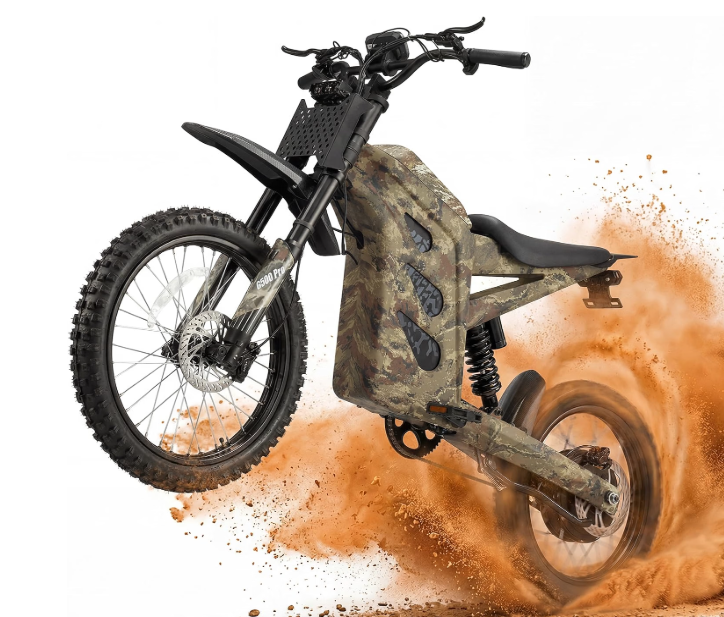
The G300 Pro is the most complete package at this price point. It’s not the most powerful or the fastest, but it balances speed, range, load capacity, and real-world usability better than its competitors. For most adult men buying in this category, it’s the right call.
The 6,500W peak hub motor runs on a 72V system. That high voltage produces responsive throttle feel and strong sustained power delivery. The five-speed mode system — capping at 13 mph, 25 mph, 28 mph, and the fully unlocked off-road mode — gives you genuine flexibility depending on where you’re riding.
The 350 lb load capacity is the standout number. Most bikes in this category top out at 220–265 lbs. The G300 Pro’s higher limit makes it accessible to a much wider range of adult riders, including larger men who’d be over capacity on competitor bikes.
The 72V 30Ah battery at 2,160Wh is one of the more substantial packs in this price range. HappyRun claims 70–76 miles of mixed-mode range, which aligns with what published reviewers have observed in real-world testing at lower speeds. At full throttle, expect 20–30 miles.
One reviewer who put real trail miles on it confirmed: battery swap-outs take about ten seconds with the quick-release design, the torque is strong enough to climb loose dirt grades without bogging, and the five-mode system makes the learning curve much more manageable than a single-mode full-power bike.
HappyRun is based in California and has a US dealer network offering test rides and service — a meaningful differentiator for a high-dollar purchase you can’t return once you’ve ridden it hard.
What to watch for: It’s heavy. Hub motor, large battery, and a steel frame add up to something in the 110–130 lb range. Moving it without a loading ramp is a two-person job. Assembly arrives 85% complete — handlebars and front wheel installation, roughly 30 minutes.
2. Freego N5 — Best for Technical Off-Road Riding
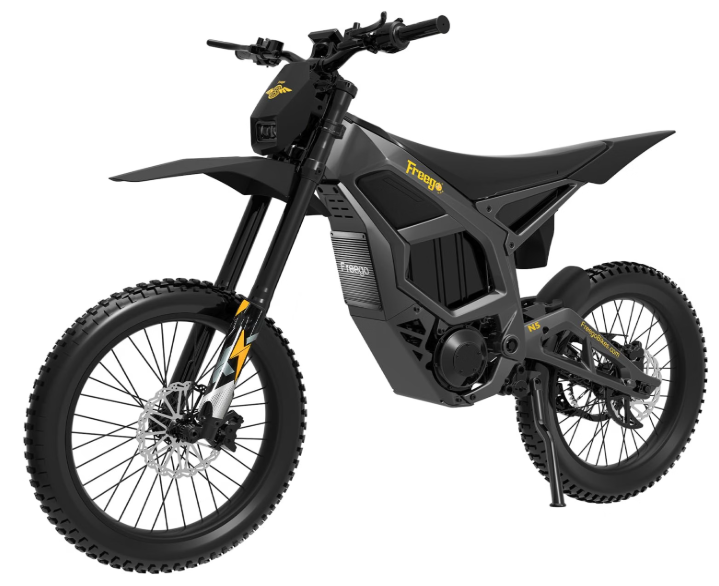
If you plan to do serious technical off-road riding with real elevation gain and challenging terrain, the Freego N5’s mid-drive motor system justifies its higher price.
The 8,000W peak output and 380 N·m of torque are the highest in this comparison. A mid-drive working through the gear system handles sustained steep climbs better than a hub motor because it multiplies torque rather than just throwing watts at the hill. Manufacturer specs show a 40° climbing capability — that’s significant, and it shows up in real-world use on challenging grades.
The 4-piston hydraulic brakes with 220/200mm oversized rotors are a genuine upgrade over the two-piston setups on most bikes in this category. Four pistons clamp harder and dissipate heat more effectively under repeated hard braking on long downhills. For technical terrain where you’re loading the brakes consistently, the difference is tangible.
The 72V 40Ah battery at 2,880Wh is the largest pack in this comparison. More capacity at the same voltage means more range at speed — a real advantage for longer sessions. Freego rates it at 70 miles in eco mode, 40 miles at 40 mph in Sport mode.
The downside is mechanical complexity. Mid-drive motors put more stress on the chain and sprockets. Drivetrain wear accelerates with aggressive riding, especially on rough terrain. This isn’t a dealbreaker, but it means more frequent drivetrain inspection and replacement compared to a hub motor setup. For an experienced rider doing regular off-road work, the trade is worth it. For a casual weekend rider, the hub motor simplicity of the G300 Pro makes more sense.
3. COSWHEEL R6000 — Best Budget Pick
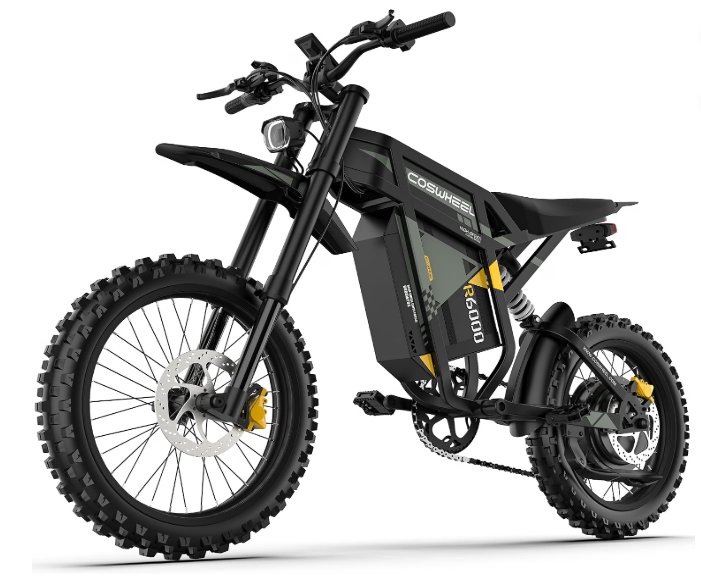
The R6000 undercuts the G300 Pro on price while delivering 55 mph top speed and a lighter frame. If budget is the primary constraint and you’re under 200 lbs, it’s worth a serious look.
The 60V electrical system produces slightly less responsive throttle feel than a 72V setup — the difference is real but subtle. The 7,000W peak motor delivers strong performance on open land. The 180mm inverted front suspension is genuine hardware, not budget filler.
The 7-speed Shimano derailleur is a practical feature in this category. It gives you real pedaling range in lower assist modes, which matters for extending range on longer rides. Most bikes at this power level treat pedaling as an afterthought; the R6000 gives you a functional drivetrain.
The UL 2849 certification is the standout value proposition. This covers the entire electrical system — battery, charger, and controller together — and is the same certification now required for e-bike sales in California and New York. It’s a meaningful safety indicator in a category full of unverified claims.
Where it loses ground: the 60V 30Ah battery (1,800Wh) is smaller than the G300 Pro’s 72V pack. At equivalent speeds, you’ll see less range. And COSWHEEL doesn’t prominently publish a maximum load capacity — contact them directly before buying if you’re above 200 lbs.
At 121 lbs, it’s meaningfully lighter than the G300 Pro, which makes transport and maneuvering noticeably easier.
Real-World Usability
Getting It to the Trail
These bikes weigh 110–130 lbs fully loaded. You’re not throwing one in a car trunk. You need a pickup truck bed with a loading ramp, a trailer, or a purpose-built motorcycle carrier rated for this weight class. Factor that into your setup costs before buying.
Charging and Battery Care
The G300 Pro and R6000 charge to 80% in around 2–2.5 hours using their fast chargers. Full charge takes 4–6 hours. Standard 110V household outlets work fine.
Cold temperature battery care matters more than most buyers realize. Lithium cells lose 20–30% capacity in temperatures below 40°F. More critically: charging a cold battery — especially below freezing — causes permanent capacity damage through a process called lithium plating. If you store this bike in an unheated garage over winter, bring the battery inside to room temperature before you charge it. Understanding your battery’s chemistry pays back in long-term capacity and cycle life. The best 18650 battery guide covers cell chemistry basics that apply here too, even though these bikes use different cell formats.
Maintenance Reality
Hub motor bikes (G300 Pro, R6000) are simpler to maintain than mid-drives. The motor is sealed in the hub and largely maintenance-free. What needs attention:
- Brake pad wear — inspect regularly; at these speeds, thin pads are a safety issue
- Brake fluid — replace hydraulic fluid annually
- Tire pressure — check before every ride; underinflated tires at 50 mph are dangerous
- Spoke tension — aggressive off-road riding loosens spokes; check every few hundred miles
- Rear axle nuts — re-torque after every few rides on rough terrain
If you run into controller behavior issues — erratic throttle response, cutting out under load, fault codes — the e-bike controller troubleshooting guide covers diagnostic approaches, though controllers at this voltage and power level have some failure modes specific to high-current systems.
Weather Use
None of these bikes publish a specific IP waterproofing rating in their specs. Light rain is generally manageable. Riding through deep water, hosing the bike down for cleaning, or leaving it exposed to heavy rain over time risks water intrusion at electrical connectors and controller housing. These bikes are off-road machines, not city commuters designed for daily wet conditions.
Comfort and Fit
Riding Position
The riding position on all three bikes is a standard dirt bike / motocross stance — upright with a slight forward lean, footpegs wide, handlebars at roughly mid-chest height when seated. It’s designed for active riding — weight shifting, standing through rough terrain, and bike control at speed. It’s not a cruiser position.
Seat Height and Rider Fit
Most bikes in this category have seat heights between 33–36 inches. Riders under 5’6″ may have trouble getting a flat foot down at standstill. Verify the seat height spec before buying if you’re shorter than average — for trail and off-road riding, not reaching the ground confidently at a stop creates a real handling problem.
Weight Capacity
The G300 Pro’s 350 lb limit is the most generous in this comparison. The Freego N5 caps at 264 lbs. The COSWHEEL R6000 doesn’t publish a clear spec — ask before buying if you’re above 200 lbs. Exceeding a rated load limit isn’t just a performance issue at these speeds; it’s a structural safety concern.
Build Quality and Components
Frame
The G300 Pro and R6000 use high-carbon steel frames — heavier than aluminum but durable and somewhat more forgiving of hard impacts before catastrophic failure. The Freego N5 uses a forged aluminum alloy frame, which saves meaningful weight but requires more precise manufacturing to achieve equivalent strength.
At 50 mph, frame integrity is a real safety factor. These manufacturers have designed these frames for the power and weight involved, but inspect the frame regularly for cracks around welds, especially at the head tube and rear dropout.
Motor and Battery Cell Quality
The G300 Pro’s battery uses Samsung or LG cells depending on production run — name-brand cells with published performance characteristics and consistent quality control. The Freego N5’s specs list LG cells specifically. Name-brand cells have longer cycle life, more stable capacity across their lifespan, and better thermal management than anonymous generic cells. For a $2,000+ machine, this distinction matters over years of use.
Display and Controls
Color LCD displays are now standard across this category. You get speed, PAS mode, battery percentage, odometer, and fault code readouts. The G300 Pro’s color display with multiple speed mode selection is user-friendly. NFC unlocking (on the R6000) adds a layer of theft deterrence and is genuinely convenient — tap your phone to unlock rather than fumbling for keys.
🔧 From the Repair Bench
High-powered hub motors in this wattage range put serious stress on rear wheel spoke tension and the motor axle interface. If you’re doing regular aggressive off-road riding — jumps, rough trails, heavy landings — check spoke tension every 300–500 miles. Loose spokes at these speeds cause subtle wheel flex that affects handling before you feel it as a wobble. The rear axle dropout is another watch point: make sure axle nuts are torqued to spec after every few hard sessions. These aren’t brand-specific problems — they show up consistently across the category when riders push these machines hard and skip routine hardware checks. Hydraulic brake fluid also degrades faster under heat cycling from repeated heavy braking, which is very common in off-road use. Annual fluid replacement isn’t optional at these speeds — it’s the difference between consistent brake feel and a spongy lever when you need it most.
50 MPH E-Bike vs. Competitors: How This Category Stacks Up
| Catagories | 50 MPH E-Bike Category | Class 3 E-Bike (28 mph) | Gas Dirt Bike |
| Top Speed | 50+ mph | 28 mph | 60–80+ mph |
| Street Legal | No (most states) | Yes | No (most areas) |
| Noise | Near-silent | Near-silent | Loud |
| Fuel Cost | ~$0.10/charge | ~$0.10/charge | $5–$15/session |
| Maintenance | Moderate | Low | High |
| License Required | Varies by state | No | Off-road: usually no |
| Starting Price | ~$2,200 | ~$900 | ~$3,000–$5,000 new |
| Off-Road Capable | Yes — purpose built | Limited | Yes |
For riders who want something in between — faster than a Class 3 e-bike but fully street-legal — there’s no great middle ground under current US law. The class system has a hard ceiling at 28 mph for legal e-bikes. Above that, you’re in motor vehicle territory regardless of pedals.
Who Should Buy a 50 MPH Electric Bike for Adults?
- Landowners and rural riders. If you have a farm, ranch, large private property, or rural land where you can ride without road regulations applying, this category makes practical sense. Covering ground quickly, checking fence lines, moving between outbuildings — a quiet, fast, zero-fuel electric machine is genuinely useful.
- Off-road park and trail riders. Off-road parks, private trail systems, and closed-course facilities that welcome electric dirt bikes are the natural home for these machines. No noise complaints, no emissions, lower operating cost than gas.
- Experienced motorbike riders going electric. If you’ve ridden dirt bikes or motorcycles before, the learning curve is about adapting to instant electric torque delivery rather than learning basic two-wheel control. That adaptation is faster and safer than starting from scratch on a 50 mph machine.
- Buyers planning to register as a motor vehicle. If you go through the registration process — using a Certificate of Origin and your state’s moped or motor-driven cycle classification — these bikes can be street-legal on public roads. It’s more paperwork than riding a standard e-bike, but it’s a real option in most states.
Who Should NOT Buy a 50 MPH Electric Bike for Adults?
- Legal commuters. If you want to ride bike lanes, multi-use paths, and public roads without additional registration and licensing, a Class 3 e-bike is your answer. The difference in legal complexity between Class 3 and this category is large.
- Beginners with no motorbike experience. Fifty miles per hour on an electric machine with instant torque delivery is not a beginner situation. If you’ve never ridden a dirt bike or motorcycle, start somewhere slower. All three bikes offer lower-speed modes, but the machine’s capability doesn’t disappear because you’re using a lower mode — you have to be able to handle it if something goes wrong.
- Riders without off-road access. If you live in a suburb or apartment without access to private land or an off-road facility, a 50 mph dirt bike has nowhere to go legally. You’ll end up riding illegally or not riding at all. The electric trike vs. e-bike comparison is a better starting point if your riding is urban and recreational.
- Anyone expecting 70 miles at 50 mph. The range math doesn’t work that way. If your planning depends on full-speed long-distance riding, revise your expectations before buying or reconsider the category.
Is a 50 MPH Men’s Electric Bike Worth It?
For the right buyer — yes. Clearly.
The performance these machines deliver at $2,000–$3,000 would have cost two to three times as much from a specialist electric motorcycle brand just a few years ago. The G300 Pro specifically hits a price-performance point that’s hard to argue with if you have land to ride on and the riding experience to use it safely.
What matters is buying honestly. These are not street commuters. Not beginner bikes. Not long-range touring machines at full speed. But as off-road electric performance machines, they are genuine.
If you’re on the fence because you want something for occasional trails and regular commuting, a quality Class 3 e-bike handles both. The jump from standard e-bike to this category is bigger than spec sheets make it look — in legal complexity, physical mass, and the skill required to ride safely.
But if off-road performance on your own terms is what you’re after — this is the category for it, and the three bikes above are legitimate starting points.
Frequently Asked Questions
Are men’s electric bike for adults 50 MPH legal to ride on public roads?
In most US states, no — not as an electric bicycle. Machines with motors over 750W and speeds above 28 mph fall outside standard e-bike classification. They’re typically treated as mopeds or motor vehicles, which require registration, insurance, and often a license. Some states allow buyers to register them using a Certificate of Origin. Check your state’s DMV classification rules before riding on public roads.
What’s the difference between peak and continuous motor power?
Peak power is the maximum a motor produces during hard acceleration or climbing — short bursts. Continuous power is what it can sustain over time without overheating. A “6,500W motor” typically means 6,500W peak and around 3,000W continuous. Peak power governs acceleration. Continuous power determines how the motor handles sustained load. Brands that only advertise peak numbers without continuous ratings are leaving out important information.
How do I actually get close to the advertised range?
Ride in the lowest speed mode, use pedal assist, avoid aggressive acceleration, maintain tire pressure, and ride on flat terrain in mild temperatures. Range figures are calculated under those conditions. At full throttle doing 45–50 mph, real-world range is roughly 25–35% of the maximum stated figure.
Do I need a motorcycle license for one of these?
On private property, typically no. On public roads, most states classify a 6,500W, 50 mph electric machine as a moped or motor vehicle — which requires appropriate licensing. The exact rules vary significantly by state. Check with your state’s DMV before riding on any public road.
What safety gear do I actually need?
At minimum: a DOT-rated motorcycle helmet (not a bicycle helmet — bicycle helmets are not impact-rated for 50 mph), motorcycle gloves, a jacket with CE-rated armor at shoulders and elbows, and knee/shin guards. At these speeds, a fall is a serious event. Riding in street clothes at 50 mph on a dirt bike is not a reasonable choice.
How do these bikes handle cold weather?
Lithium battery capacity drops 20–30% below 40°F. The bikes will still run in cold weather, but range shortens noticeably. More critically: never charge a cold battery — charging below freezing causes permanent cell damage through lithium plating. Store the battery indoors if temperatures drop below freezing, and let it warm to room temperature before connecting a charger.
How hard is assembly out of the box?
The G300 Pro ships 85% assembled — front wheel and handlebars installation, roughly 30 minutes with the included tools and video guide. The other bikes are similar. If you’re uncomfortable with basic mechanical assembly, a local motorcycle shop can do the setup for a modest fee and verify brake bleed and torque specs at the same time.
Can I ride one of these on hiking trails or public bike paths?
Almost certainly not without additional registration and licensing. Most public trail systems have specific rules about motorized vehicles, and a 50 mph electric machine falls into that category. Always check the specific rules for any trail before you go.
Final Verdict
The HAPPYRUN G300 Pro is the right starting point for most buyers — the 350 lb load capacity, 2,160Wh removable battery, five speed modes, and US dealer support create the most complete package at the price.
If technical trail riding with real climbing is your primary use case, the Freego N5 mid-drive is worth the additional spend. The 4-piston brakes and 380 N·m torque are genuinely in a different tier for serious off-road use.
If budget is the priority and you’re under 200 lbs, the COSWHEEL R6000 with its UL 2849 certification and lighter frame is a competitive option.
Start in the lowest speed mode. Wear a real motorcycle helmet. Know what land you’re legally riding on. Do all of that, and this category is genuinely fun.