You’ve been looking at electric bikes capable of 50+ mph and now you’re not sure what you’re actually looking at. Is it an electric dirt bike? An electric motorcycle? A very powerful e-bike? Something sold as an e-bike that the DMV would call a motor vehicle?
The naming is genuinely confusing. Manufacturers don’t use these terms consistently. Legal classifications vary by state. A machine called an “adult electric dirt bike” on one website might be listed as an “electric bike for adults” on Amazon and regulated as a motorcycle at your DMV. None of those three labels is necessarily wrong — they’re just describing different things.
This article explains what actually separates electric dirt bike vs. electric motorcycle in design, performance, legal status, and real-world ownership. By the end, you’ll know which one makes sense for how you actually want to ride.
Quick Answer
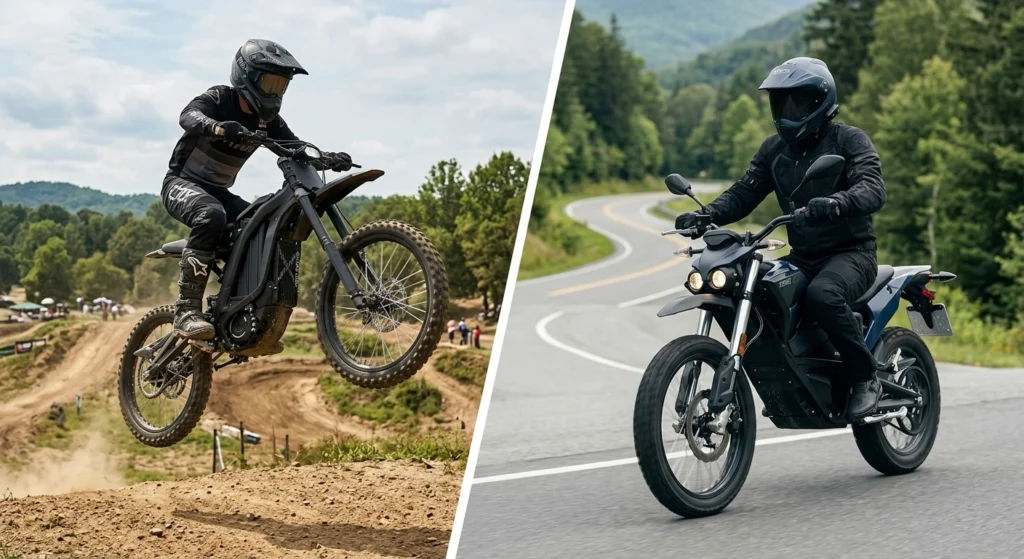
An electric dirt bike is an off-road machine. It’s built for trails, loose terrain, jumps, and rough ground. In the US, most are not street-legal without going through a motor vehicle registration process that many brands don’t support. They use knobby off-road tires and long-travel suspension tuned for dirt.
An electric motorcycle is a road vehicle. It’s NHTSA-certified, registered, licensed, and insured like any other motorcycle. It can handle light off-road terrain but it was built for pavement first.
The biggest real-world difference isn’t power or top speed. It’s legal status and where you’re allowed to ride. Everything else flows from that single distinction.
What an Electric Dirt Bike Actually Is
An electric dirt bike is an off-road electric machine. No gas engine, no clutch, no gear shifting. You twist a throttle and the motor delivers torque immediately.
The design is lifted straight from motocross and enduro racing. Long-travel suspension — typically 250–290mm front and rear on serious machines — absorbs the impact of roots, rocks, and landings that would destroy a street bike’s suspension. Knobby off-road tires grip loose dirt, sand, and mud where a road tire would slide out instantly. The frame is built to survive crashes at speed. The riding position is aggressive — upright and forward-weighted, designed for active bike control rather than comfortable cruising.
What it typically isn’t: street-legal. The product name alone cannot answer the question. Two products sold as electric dirt bikes can have completely different legal identities — one may fit a state e-bike class, one may be designed for trails or closed courses as an off-highway vehicle, and one may reach motorcycle-like speeds without the documentation that allows road use.
Brands like Sur-Ron and Talaria are the most recognized names in this space. The Sur-Ron Storm Bee is a genuine enduro machine — 22.5 kW of peak power (about 30 horsepower), a 68 mph top speed, and 520 N·m of torque, putting it in line with enduro stalwarts like the Honda CRF250X and Yamaha WR250F. Despite having EU road-legal models, as of 2025 the Light Bee X, Storm Bee, and Ultra Bee are not NHTSA certified for road use within the United States.
That means despite being a genuine high-performance machine, the Storm Bee is off-road only in the US unless the buyer goes through a state-specific registration process — which is possible in some states but not automatic.
What an Electric Motorcycle Actually Is
An electric motorcycle is a road vehicle with an electric drivetrain instead of a combustion engine.
It’s federally compliant with NHTSA motor vehicle safety standards. It has a manufacturer-assigned Vehicle Identification Number. It can be registered, titled, licensed, and insured through standard DMV procedures. You ride it to work, on highways, on any public street that allows motorcycles.
The design reflects that priority. Dual-sport or street tires work on pavement and managed dirt. Suspension travel runs 8–9 inches — capable enough for fire roads and packed trails, but not built for the sustained abuse an off-road machine handles. The Zero FX, one of the most established electric motorcycles, weighs 289 lbs, runs DOT-approved dual-sport tires, and tops out at 85 mph. It’s among the first bikes Zero Motorcycles ever brought to market, and its mission remains unchanged — nimble urban and light-off-road use.
Range is also substantially better on electric motorcycles. The Zero FX 2026 offers up to around 102 miles in city riding with its larger battery option. An off-road machine of comparable power covers 40–75 miles. Street machines carry bigger batteries because range on public roads matters in a way it doesn’t on a private trail loop.
The Part That Confuses Everyone: The Middle Ground
This is where most articles let you down, and where buyers get into trouble.
There’s an entire category of machines that sits between these two worlds. They look like dirt bikes. They perform like motorcycles. They’re commonly sold using “electric bicycle” language — partly for marketing reasons, partly because the pedals technically present allows it, partly because the full legal implications are commercially inconvenient to explain upfront.
These include machines like the HAPPYRUN G300 Pro (6,500W peak, 50 mph), the COSWHEEL R6000 (7,000W peak, 55 mph), the Sur-Ron Ultra Bee (18 kW, 55 mph), and the entire Amazon category of high-powered “adults electric bikes” — machines that appear in our full buying guide for 50 mph electric bikes.
None of these are e-bikes in the legal sense. None are street-legal electric motorcycles either. They occupy a genuine gray zone — off-road machines with motorcycle-level performance that require the same legal approach as an electric dirt bike regardless of how the product page describes them.
The key practical framework: under 20 mph often fits Class 2 e-bike rules, up to 28 mph aligns with Class 3, 29–35 mph tends toward moped status, and above that is usually motorcycle territory. Each band comes with escalating requirements — from helmets and age limits to licenses, registration, plates, and insurance.
A 50 mph machine with a 6,500W motor doesn’t fit Class 3. On private property, that’s fine — you don’t need to classify it. On public roads, law enforcement increasingly understands the difference. Attempting to classify an electric dirt bike as an e-bike can lead to fines or confiscation. Enforcement has increased nationwide, particularly in cities. Problems arise when electric dirt bikes are ridden like street motorcycles without compliance.
Side-by-Side: The Real Numbers
This comparison uses two actual machines at roughly comparable performance levels to show what the differences look like in practice.
Sur-Ron Storm Bee — purpose-built off-road electric dirt bike, ~$8,499–$10,500
Zero FX 2026 — street-legal electric dual-sport motorcycle, ~$12,499
| Factor | Sur-Ron Storm Bee | Zero FX 2026 |
| Weight | 286 lbs | 289 lbs |
| Peak Power | 22.5 kW (~30 hp) | ~34 kW (~46 hp) |
| Top Speed | 68 mph | 85 mph |
| Range | 75 miles (claimed, eco) | 102 miles (city, large battery) |
| Front Suspension Travel | 290mm | 8.6 in (218mm) |
| Tire Type | Off-road knobby | Dual-sport (street/dirt) |
| Street Legal (US) | ❌ Off-road only | ✅ Yes |
| DMV Registration | Not standard | Required |
| License Required | Private land: No | Yes — motorcycle endorsement |
| Annual Insurance Cost | Not applicable (off-road) | ~$600–$950/year |
| Starting Price | ~$8,499 | ~$12,499 |
| Best For | Trails, private land, OHV | Road commuting + light trail |
The Zero FX is faster on public roads, fully street-legal, and covers more distance on a charge. The Storm Bee has better suspension for serious trail riding and costs less at the entry point. Neither outright beats the other — they serve genuinely different purposes.
What Actually Separates Them When You’re Riding: Electric Dirt Bike vs. Electric Motorcycle
Tires — the Most Overlooked Difference
This is the most functionally important distinction in real riding, and the least discussed.
Off-road electric dirt bikes use knobby tires designed for loose dirt, sand, mud, and rock. They grip terrain where a road tire loses traction entirely. On pavement, those same tires wear faster, generate noise, and feel vague at highway speeds.
Electric motorcycles use dual-sport or street tires — predictable on pavement, adequate on hard-packed dirt, genuinely risky on loose rock or deep mud at speed.
You can swap tires on a road motorcycle to more aggressive treads. But you can’t fix the suspension, and you can’t change the bike’s legal classification by swapping rubber.
Suspension
The Storm Bee has the girth and heft of a grown-up’s motorcycle with wheels, tires, footpegs, handlebars, and controls to match. That includes suspension travel designed for drops, jumps, and impacts that would damage a road bike’s hardware. 290mm of travel front and rear is motocross-level equipment.
The Zero FX’s long travel suspension — Showa 41mm fully adjustable at 8.6 inches front, Showa monoshock at 8.94 inches rear — is among the best in electric dual-sport and handles light off-road capably. It’s not motocross suspension. It’s excellent dual-sport suspension. Those aren’t the same thing.
Range and How It’s Actually Used
Road machines are built for distance. You want confidence that a 35-mile daily commute doesn’t deplete the battery. The Zero FX’s 100-mile city range is genuinely useful for that.
Off-road machines run shorter, more intense sessions. A two-hour trail session on a Sur-Ron Storm Bee might cover 20–40 miles of actual distance at wildly varying speeds and loads. The 75-mile claimed range still gives comfortable buffer for that use pattern.
If your plan is to ride to a trail, ride the trail hard, and ride home — one machine is doing two different jobs, and each job wants different hardware.
Noise
Both categories are near-silent compared to gas. But there’s a meaningful practical consequence for off-road use specifically.
Electric dirt bikes operate almost silently by comparison to gas bikes. Trail riders appreciate the quiet operation and smooth torque of electric bikes. Gas bikes still appeal to riders who prefer traditional engine characteristics and long-distance riding without needing to recharge.
The silence opens trail access that gas machines have lost to noise ordinances. OHV parks and trail systems that restricted gas bikes due to sound are increasingly welcoming electric alternatives. That’s one of the most practically meaningful advantages of the off-road electric category — not just less noise, but more places to ride.
The Legal Reality, Explained Simply
Most articles give you one sentence here. This topic deserves more than one sentence.
Think of vehicle classification as a chain:
Design → Manufacturer Certification → Documentation (VIN) → Equipment → Registration
A vehicle designed for off-road use, without NHTSA certification, without a VIN, and without road safety equipment is an off-road vehicle. Adding a headlight doesn’t change that. A street-legal electric dirt bike must satisfy federal safety equipment standards and your state’s definition of a legal vehicle, whether bicycle, moped, or motorcycle. The manufacturer must have produced and documented the vehicle for public-road use, and the owner must still complete the applicable state registration process.
What this means in practice:
| Riding Location | Off-Road Dirt Bike | High-Powered “E-Bike” (50 mph) | Street-Legal Electric Motorcycle |
| Private land / farm | ✅ Legal | ✅ Legal | ✅ Legal |
| OHV / off-road park | Usually ✅ | Usually ✅ | Sometimes ✅ |
| Public bike paths | ❌ | ❌ | ❌ |
| Public roads | ❌ Without registration | ❌ Without registration | ✅ Fully legal |
Standard e-bikes do not require registration, a title, or insurance. Electric dirt bikes, being classified as motor vehicles, almost always do. If you plan to ride your electric dirt bike legally, even just in OHV parks, you will likely need to register it with your state’s DMV or equivalent agency.
For the full picture of how e-bike classification works at the state level, the new e-bike battery laws by state (2026 update) explains the evolving landscape and what’s changing for high-powered machines. If you’re wondering whether your existing setup or conversion might cross the legal line, the electric bike conversion kit legality guide covers how the class system draws those boundaries.
What Most People Get Wrong
“It’s called an e-bike so I can ride it on bike paths.”
The most common and most consequential misconception.
Marketing language doesn’t determine legal classification. A machine doing 50 mph with a 6,500W motor is not a Class 3 e-bike. It cannot legally use bike lanes, multi-use trails, or sidewalks reserved for e-bikes in most US states. Riders who stay on private property or trails rarely encounter issues. Problems arise when electric dirt bikes are ridden like street motorcycles without compliance.
“Electric dirt bikes are just faster e-bikes with bigger motors.”
No. A standard 750W commuter e-bike and a 6,500W off-road machine share an electric drivetrain. That’s roughly where the similarity ends. One is built around the bicycle experience — pedal assistance, bicycle geometry, bicycle-weight components. The other is a motorcycle with a different power source. Different brakes, suspension, tires, frame geometry, power system, and legal identity. Treating them as points on the same spectrum leads to bad buying decisions.
“You can make any electric dirt bike street-legal by adding lights.”
You can add lights, mirrors, and a horn to any machine. That doesn’t make it street-legal. The key is not the number of accessories bolted on later. The manufacturer must have produced and documented the vehicle for public-road use, and the owner must still complete the applicable state registration process. Adding an Amazon lighting kit to a Sur-Ron Light Bee doesn’t change its regulatory classification. Some states offer a moped or motor-driven cycle registration path for machines that meet their power and speed thresholds — that’s a different process, and it requires a manufacturer’s Certificate of Origin, not just hardware additions.
“Electric motorcycles are strictly for highway riders.”
The Zero FX’s long-travel suspension and lack of clutch or transmission make it an undeniably capable performer in the dirt alongside its street abilities. It handles fire roads, hard-packed trails, and light single-track competently. You wouldn’t take it through the same technical terrain as a purpose-built dirt machine, but it’s not a pavement-only bike.
How Much Does Each Category Actually Cost to Own?
Sticker price is only part of the picture. Here’s a realistic cost framework across the first three years of ownership for each category.
| Cost Item | Off-Road Electric Dirt Bike | Street-Legal Electric Motorcycle |
| Purchase price | $2,500–$10,500 | $10,000–$15,000 |
| Registration (3 yr) | $0 (private use) | $300–$600 |
| Insurance (3 yr) | $0 (private use) | $1,800–$3,000 |
| Motorcycle license | Not required (private) | $50–$200 (varies by state) |
| Fuel/electricity (3 yr) | $150–$300 | $300–$600 |
| Brakes, tires, consumables | $600–$900 | $900–$1,500 |
| Estimated 3-yr total | $3,400–$12,000 | $13,350–$20,900 |
For private off-road use, the cost gap between categories is actually wider than the sticker price alone suggests. Electric motorcycles carry ongoing operational costs that private-use dirt bikes don’t. For road commuting, the electric motorcycle’s fuel and maintenance savings vs. a gas motorcycle are real — electricity is roughly eight times cheaper per mile than pump gas, and maintenance shrinks to a short checklist with no oil changes or valve adjustments.
Factors That Change the Right Answer
Where you plan to ride. This is the single biggest factor. Private land, farm, ranch, closed off-road course — either category works without legal complications. Public trails and OHV parks — check the specific rules for each, but electric machines are increasingly welcome. Public roads — electric motorcycle wins outright.
Your riding experience. High-powered off-road electric machines at 50+ mph require genuine riding skill. Instant electric torque on loose terrain demands technique that comes from experience. If you’ve ridden gas dirt bikes or motorbikes, the transition is manageable. Starting from zero on a 50 mph off-road machine is a safety issue, not just a comfort issue.
Transport and storage. Lighter off-road machines (Sur-Ron Light Bee X at 125 lbs, Ultra Bee at 187 lbs) are significantly easier to transport than 280+ lb electric motorcycles. Truck bed, van floor, purpose-built hitch carrier — all work. Full electric motorcycles typically need a motorcycle trailer or a truck with a proper ramp and tie-down setup.
Maintenance expectations. Electric motors have far fewer moving parts and do not require oil changes, spark plugs, or fuel system maintenance. The primary maintenance tasks for an electric dirt bike are inspecting brakes, replacing brake pads, maintaining tires, checking chain tension or belt systems, and keeping the battery properly charged and stored. For road motorcycles, add DOT tire wear from pavement use and ABS system maintenance. The biggest long-term variable in both categories is battery health — how you charge, store, and discharge the pack directly affects capacity over years of ownership. The guide to 21700 battery cells covers cell quality and what actually kills capacity over time, which applies to any high-dollar electric vehicle purchase.
Torque and power delivery. Both categories deliver instant torque from zero RPM — that’s the defining characteristic of electric drivetrains. The practical difference is in how much and how controllable. The guide to which e-bikes have the most torque gives useful context on how torque numbers translate to real riding feel, even if most of those machines are in the commuter e-bike class.
Choose an Electric Dirt Bike If…
- You have private land, farm, ranch, or dedicated off-road property to ride on
- OHV parks, private trail systems, or closed-course riding is your primary plan
- Technical off-road riding is the main goal, not road transportation
- Budget matters — off-road electrics generally deliver more performance per dollar at comparable price points
- You want a quiet, low-maintenance replacement for a gas dirt bike
- You’ve already ridden dirt bikes or motorbikes and can handle this power level
Choose an Electric Motorcycle If…
- You need to commute legally on public roads without additional registration complexity
- One machine for both pavement commuting and light off-road use is the goal
- You live somewhere without private off-road access
- Range over 75 miles matters for your typical trip length
- You’re comfortable with motorcycle licensing, registration, and insurance requirements
- Long-term street riding is more likely than regular off-road sessions
Consider Neither If…
- You’re a first-time rider with no motorbike experience — a Class 3 e-bike is the right starting point
- You want legal bike-path access at speeds above 28 mph — that doesn’t exist in the US e-bike class system, regardless of which category you buy
- You expect either category to do what the other is genuinely better at
🔧 From the Repair Bench
The most common thing I see go wrong with high-powered “electric bike” purchases is buyers assuming the marketing category matches the legal category. A machine sold as an “adult electric mountain bike” that does 50 mph and pulls 6,000+ watts peak is not a mountain bike in any legal or mechanical sense — it’s a motor vehicle, and most riders figure that out after an encounter with law enforcement rather than before. The second most common issue is controller thermal cutout at sustained high speed in hot conditions. These machines run controllers near their rated ceiling under full throttle. If you’re seeing power cut in and out during a long hard run on a warm day, that’s the thermal protection working as designed — not a failed motor. Give it five minutes, it resets. Sustained full-throttle riding above 90°F is genuinely hard on controllers in this power range. If it’s happening regularly, ride in a lower speed mode during the hottest part of the day. The e-bike controller guide covers how these systems work and what to watch for when troubleshooting electrical behavior.
Frequently Asked Questions
Can I make my electric dirt bike street-legal?
Some states allow registration of high-powered electric machines as mopeds or motor-driven cycles. To do it, you typically need a manufacturer’s Certificate of Origin, and the machine must meet the state’s power and speed thresholds for that vehicle class. You’ll also need to add road safety equipment (headlight, brake light, turn signals, mirrors, horn, DOT-rated tires) and complete the registration process. This is state-specific and not automatic — contact your DMV directly with the machine’s specs to find out what’s required before buying.
Do I need a motorcycle license for an electric dirt bike?
On private property, typically no license is required. On public roads, it depends on how your state classifies the specific machine. For electric dirt bikes, the answer is almost always yes for public road use — because they are classified as motor vehicles, some form of licensure is typically required. This could be a standard driver’s license, a motorcycle endorsement, or a specific moped license, depending on your state’s regulations.
Are electric dirt bikes allowed on OHV trails?
Most OHV trail systems that allow gas machines are increasingly welcoming electric alternatives. The quiet operation and zero emissions are strong points in their favor. Always check the specific rules for the trail system you’re visiting — some have power limits or class restrictions. Trail access is one of the better-kept secrets of the off-road electric category.
What’s the difference in battery size between these two categories?
Electric motorcycles typically carry larger packs designed for sustained road range. The Zero FX 2026 carries a 7.2 kWh battery in its larger configuration. Off-road machines use smaller packs built for intense but shorter sessions — the Sur-Ron Storm Bee carries a 5.75 kWh pack. Range per charge is lower on off-road machines, but the riding pattern (shorter, more intense sessions) means it rarely matters in practice.
What happens if I ride an electric dirt bike on a public road without registration?
Enforcement has increased nationwide, particularly in cities. Police departments are responding to complaints about unregistered electric vehicles on roads. Typical penalties include a traffic citation for operating an unregistered motor vehicle, fines in the $200–$1,000 range for first offenses, and potential impoundment. The “but it’s technically an e-bike” argument is not working reliably in enforcement situations.
Is there a machine that handles both road and serious off-road well?
The Zero FX comes closest. Its Showa 41mm fully adjustable forks and monoshock rear give it real off-road capability, and it handles light to moderate trails competently. It’s street-legal, insured, and can commute daily. What it gives up is the dedicated suspension travel and off-road tire capability of a purpose-built trail machine. For someone whose riding is 70% pavement and 30% dirt, it’s the most capable legitimate option currently available.
How do maintenance costs actually compare per year?
Annual maintenance costs average $300–$500 for gas dirt bikes versus $100–$200 for electric models. For street-legal electric motorcycles used as daily commuters, add registration, insurance, and faster tire wear from pavement. Electric dirt bikes on private property carry lower ongoing costs — primarily tires, brake pads, and brake fluid. Both categories are dramatically cheaper to operate than gas equivalents over multi-year ownership.
Are these machines appropriate for beginners?
The high-powered 50+ mph off-road category — no. Instant electric torque at these power levels requires riding skill you develop from experience. Lower-power electric machines in the 2,000–3,000W range with supervised riding are the appropriate entry point. For first-time riders who want electric transportation, a standard Class 3 e-bike is the right starting point before moving into either of these categories.
Bottom Line
Electric dirt bikes and electric motorcycles are not interchangeable categories with a marketing distinction between them. They’re different machines built for different purposes, with different legal identities and different real-world ownership realities.
Electric dirt bike → built for off-road, trail, and private land. Simpler legal situation on private property, more complex on public roads. Better purpose-built performance per dollar at comparable price points. More trail access than gas alternatives due to noise and emissions. Not street-legal without going through a registration process most brands don’t automatically support.
Electric motorcycle → built for road use first. Street-legal from the factory, usable for daily commuting, appropriate for public roads in every state. Less purpose-built for serious off-road terrain. Higher sticker and ongoing ownership cost.
The high-powered Amazon “e-bike” middle ground → legally an off-road machine, regardless of how it’s marketed. Treat it the same way you’d treat an electric dirt bike for legal and safety purposes.
If you’re deciding which category fits your life, start with one question: where are you actually going to ride? That single answer resolves most of the confusion.