Choosing an electric bike is exciting. But once you start looking at motor sizes, things can get confusing.
One of the most common questions riders ask is:
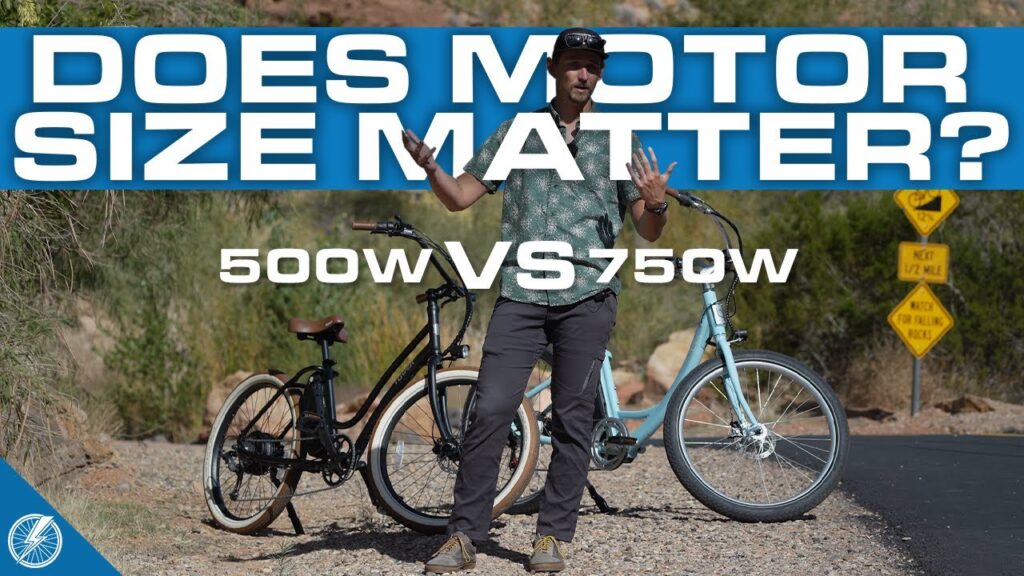
Should I choose a 500W or 750W electric bike?
Quick answer
Most riders are happier with 500W. Power riders should choose 750W.
If you mostly ride on flat roads, bike paths, and city streets, a 500W electric bike is usually enough. It is lighter, cheaper, and often gets better range.
If you regularly climb steep hills, carry cargo or a passenger, or want faster acceleration, a 750W electric bike is the better choice.
500W: Efficient commuter
750W: Strong hill climber
What Does 500W or 750W Mean?
A watt (W) is a unit of power. In an electric bike, it tells you how much power the motor can produce.
Think of it like this:
500W motor
Moderate power
Good for commuting, bike paths, and moderate hills.
750W motor
High power
Better for steep hills, heavier riders, cargo, and stronger acceleration.
More watts generally mean:
- Faster acceleration
- Better hill climbing
- More pulling power
- Better performance under heavy loads
However, more power also means higher energy consumption.
That is why bigger isn’t always better.
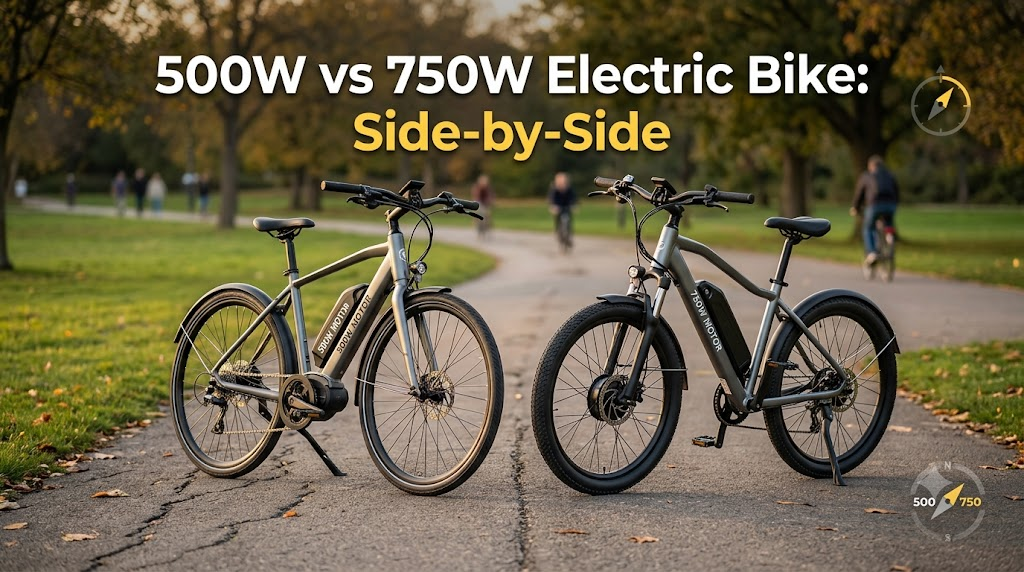
500W vs 750W Electric Bike: Side-by-Side
Here’s the major difference between 500W and 750W electric bike:
| Feature | 500W E-bike | 750W E-bike |
| Best for | Commuting | Hills & cargo |
| Typical top speed | 20–24 mph | 25–28 mph |
| Acceleration | Moderate | Strong |
| Hill climbing | Good | Excellent |
| Range (same battery) | Longer | Shorter |
| Bike weight | Usually lighter | Usually heavier |
| Cargo capacity | Moderate | Better |
| Price | Lower | Higher |
| Urban Commuting | Excellent | Very good |
| Off-Road Riding | Good | Excellent |
| Steep Hills | Fair to good | Excellent |
| Legal status (U.S.) | Widely legal | Usually the maximum legal limit |
For many riders, this table alone gives a good idea of the differences.
But let’s dig deeper.
Power and Speed: What You’ll Actually Feel
On paper, 750W is only 250 watts more than 500W. On the road, it feels like a much bigger jump.
500W feels like a strong tailwind
It helps you cruise comfortably and makes city riding easy.
750W feels like a push from behind
It launches harder from traffic lights and keeps speed better on climbs.
Real-world speed
Speed is usually the first thing buyers want to know about.
| Motor | Typical assisted speed |
| 500W | 20–24 mph |
| 750W | 25–28 mph |
Actual speed depends on several factors:
- Rider weight
- Tire size
- Terrain
- Wind conditions
- Battery voltage
- Local speed restrictions
A common mistake is assuming that a 750W bike is dramatically faster.
In reality, the difference may only be a few miles per hour.
If your daily rides are on city streets or bike paths, that extra speed may not matter much.
For longer commutes or open roads, however, the stronger motor can help maintain higher speeds more comfortably.
Which Motor Accelerates Faster?
Acceleration refers to how quickly the bike reaches its cruising speed.
This is where a 750W motor begins to show its advantage.
Imagine starting from a stoplight.
A 500W bike moves away smoothly and steadily.
A 750W bike feels more responsive and powerful.
The extra power helps:
- Reach cruising speed faster
- Merge into traffic more easily
- Start on steep inclines
- Handle heavier riders
Many riders notice this difference immediately during a test ride.
If you enjoy a more energetic ride, a 750W motor feels noticeably stronger.
Hill Climbing: The Biggest Difference
This is where 750W clearly wins.
A 500W bike can handle:
- Flat roads
- Rolling terrain
- Small hills
- Riders who are willing to pedal
Most riders have no issues climbing typical city hills.
However, very steep grades can slow the bike down.
You may need to:
- Shift gears
- Pedal harder
- Reduce speed
A 750W bike is better for:
- Higher torque
- Better traction
- More climbing power
- Steep hills
- Heavy riders
- Cargo racks and child seats
- Off-road trails
- Riding with little pedaling
If your area has steep hills, mountains, or rough trails, the stronger motor makes a noticeable difference.
The climb feels smoother and requires less work.
Example
10% hill with groceries
A 500W bike may slow down and need more pedaling.
A 750W bike usually keeps a steadier speed with less effort.
Why? Torque.
Many buyers focus only on watts.
In reality, torque is often more important.
Torque is the twisting force that moves the bike forward.
Think about driving a truck uphill.
You don’t just need horsepower. You also need torque.
Higher torque helps with:
- Climbing hills
- Carrying cargo
- Accelerating quickly
- Riding off-road
Many 750W motors produce roughly 40–50% more torque than similar 500W motors.
That extra torque is why they feel stronger even when top speeds are similar.
Range and Battery Life
Range matters to nearly every rider. Nobody wants to run out of battery halfway through a ride.
The simple answer is:
A 500W motor usually gets better range than a 750W motor when using the same battery.
For example:
- 500W motor + large battery = excellent range
- 750W motor + large battery = strong power with good range
- 750W motor + small battery = shorter rides
That’s why you shouldn’t judge an e-bike by motor size alone.
Why 500W wins on range
A smaller motor uses less energy. If both bikes have the same battery, the 500W bike often gets 10–30% more range.
Why 750W uses more battery
More power means more energy draw, especially during acceleration, climbing, and throttle-heavy riding.
Example with the same battery
| Motor | Typical range |
| 500W | 40–60 miles |
| 750W | 30–50 miles |
Actual results vary based on:
- Rider weight
- Terrain
- Wind
- Tire pressure
- Pedal assistance level
- Throttle usage
The more aggressively you ride, the faster any battery drains.
Does a Bigger Motor Always Drain the Battery Faster?
Not necessarily.
This surprises many riders.
A 750W motor only uses its full power when needed.
If you ride gently on flat roads, battery consumption may not be dramatically different.
However, if you regularly:
- Use full throttle
- Ride steep hills
- Carry cargo
- Travel at maximum speed
Then the battery will drain faster.
That is simply the trade-off for additional power.
Weight and Handling
Most 750W e-bikes come with larger motors and often larger batteries. That adds weight.
500W advantages
- Easier to lift onto a rack
- Better for apartments and stairs
- Feels more like a regular bicycle
750W trade-offs
- Heavier to carry
- Less nimble at low speeds
- More stable at higher speeds
If you need to carry your bike up stairs every day, this difference matters more than the speed difference.
Carrying Cargo and Extra Weight
Do you plan to carry:
- Groceries?
- Camping gear?
- Work equipment?
- Child seats?
- Bike packing bags?
If so, power becomes more important.
A loaded bike requires more effort to move.
A 500W motor can handle moderate cargo.
A 750W motor feels much more comfortable when carrying heavy loads.
That is why many cargo e-bikes use larger motors.
The additional power helps maintain speed and stability even when the bike is fully loaded.
Riding Experience: How Do They Feel on the Road?
Numbers only tell part of the story.
The riding experience is often what matters most.
A 500W bike feels:
- Smooth
- Efficient
- Balanced
- Easy to control
A 750W bike feels:
- More powerful
- Faster to respond
- Stronger on climbs
- More capable under pressure
Neither feeling is wrong. Some riders prefer a natural cycling experience. Others enjoy the extra boost that comes with a larger motor.
The best choice depends on what feels right for you.
Commuting: Which Motor Is Better?
For most commuters, a 500W electric bike is more than enough.
Daily commuting usually involves:
- Bike lanes
- City streets
- Moderate distances
- Stop-and-go traffic
A 500W motor handles these situations extremely well.
It also offers:
- Better efficiency
- Lower cost
- Longer range
- Easier handling
However, commuters who face steep hills every day may appreciate the extra strength of a 750W motor.
The added power can make a challenging ride feel effortless.
Off-Road Performance
If you enjoy riding on dirt trails, gravel roads, forest paths, or uneven terrain, motor power becomes much more important.
A 500W electric bike works well on:
- Light gravel trails
- Packed dirt paths
- Park trails
- Mild off-road routes
You’ll still need to pedal when the trail gets steep or loose.
A 750W electric bike gives you more confidence on challenging terrain. The extra power helps you ride through:
- Loose gravel
- Sand
- Mud
- Rocky trails
- Steep climbs
The stronger motor also helps you recover speed after obstacles without working as hard.
If trail riding is a regular part of your adventures, a 750W motor is usually the better investment.
For riders interested in different riding styles, learning What to Look for When Buying an Electric Bike can also help you choose features that match your needs.
Cost: Is 750W Worth the Extra Money?
Generally, yes—if you need the power.
500W: Budget friendly
- Lower purchase price (You’ll often find quality models starting around: $900–$1,500)
- Lower battery consumption
- Often cheaper replacement parts
750W: Higher cost
- Higher purchase price (Many 750W electric bikes start around: $1,300–$2,500+)
- Often includes stronger brakes and drivetrain parts
- Higher battery usage over time
Simple rule
If a 500W bike meets your needs, don’t pay extra for 750W. If you’re already worried about hills or cargo, buy 750W now rather than upgrading later.
Maintenance Differences
Both motors require very little maintenance.
The motor itself is usually sealed and designed to last for thousands of miles.
However, a 750W bike may wear out certain parts a little faster because of the extra power.
These include:
- Tires
- Brake pads
- Chains
- Cassettes
This doesn’t mean maintenance is expensive.
It simply means stronger motors place slightly more stress on bike components.
Keeping your drivetrain clean and checking tire pressure regularly will help either bike last much longer.
Legal Limits in the U.S.
Important: 750W is often the legal ceiling
Under U.S. federal consumer rules, most e-bikes are limited to 750W to be treated as bicycles rather than mopeds.
In the United States, many states follow the three-class e-bike system.
Under these rules:
- Class 1: Pedal assist only, up to 20 mph
- Class 2: Throttle-assisted, up to 20 mph
- Class 3: Pedal assist, up to 28 mph
A 750W motor is generally the maximum power allowed for bikes that fall under these classes in many states.
However, laws are different depending on where you live.
Some states have additional rules about:
- Helmet requirements
- Minimum rider age
- Trail access
- Throttle use
- Maximum motor power
Always check your local regulations before buying an electric bike.
500W vs 750W Electric Bike: Pros and Cons
500W Electric Bike
Pros
- Lower purchase price
- Better battery efficiency
- Longer range
- Lighter weight
- Great for commuting
- Smooth, natural ride
Cons
- Less climbing power
- Slower acceleration
- Not ideal for heavy cargo
- Can struggle on very steep hills
750W Electric Bike
Pros
- Strong acceleration
- Excellent hill climbing
- Higher torque
- Better for heavier riders
- Handles cargo more easily
- Great for trail riding
Cons
- Higher price
- Slightly heavier
- Uses more battery under heavy loads
- May wear drivetrain components faster
Common Myths About 500W and 750W Motors
Myth 1: Bigger Motors Always Go Much Faster
Not true.
Top speed also depends on:
- Controller settings
- Battery voltage
- Tire size
- Rider weight
- Local speed limits
A 750W bike may only be a few miles per hour faster than a 500W bike.
Myth 2: A 500W Motor Isn’t Powerful Enough
For most riders, it absolutely is.
Daily commuting, neighborhood rides, and bike paths rarely require more than 500W.
Myth 3: A 750W Motor Always Drains the Battery Quickly
Not always.
Battery consumption depends on how you ride.
Using lower assist levels on a 750W bike can produce excellent range.
Myth 4: More Watts Always Mean Better Performance
Motor design matters too.
A well-built 500W motor with high torque can outperform a lower-quality 750W motor in some situations.
Look beyond the watt rating when comparing bikes.
Who Should Buy a 500W E-Bike?
Choose 500W if most of these are true
- You ride mostly on flat or gently rolling roads.
- Your commute is under 15 miles each way.
- You enjoy pedaling.
- You want the longest possible range.
- You need a lighter bike.
- You want to spend less.
Best fit: Urban commuters, bike-path riders, and fitness-focused riders who still want electric help.
Who Should Buy a 750W E-Bike?
Choose 750W if most of these are true
- You live in a hilly area.
- You weigh over ~220 lb (100 kg).
- You carry groceries, tools, or a child seat.
- You ride off-road or on loose surfaces.
- You rely heavily on the throttle.
- You want stronger acceleration.
Best fit: Riders in hilly cities, cargo-bike owners, heavier riders, and people who want the easiest ride possible.
A Simple Decision Tree
Step 1: Is your route mostly flat?
Yes → 500W is probably enough.
No → Go to Step 2.
Step 2: Do you regularly climb steep hills?
Yes → 750W is worth it.
No → Go to Step 3.
Step 3: Do you carry heavy cargo or use a throttle a lot?
Yes → 750W.
No → 500W.
Real-World Examples
Chicago commuter
Rider: 170 lb, 8-mile commute, mostly flat roads.
Best choice: 500W. Cheaper, lighter, and enough speed for city traffic.
Seattle rider
Rider: 210 lb, steep hills, rainy roads.
Best choice: 750W. The extra torque makes climbs much easier.
Family cargo bike
Rider: Child seat plus groceries.
Best choice: 750W. Better starts and less strain on hills.
Frequently Asked Questions
1. Is a 750W e-bike much faster than a 500W e-bike?
No. The top-speed difference is usually only 4–8 mph. The bigger advantage is acceleration and hill climbing.
2. Does a 500W e-bike get better range?
Usually yes. With the same battery, a 500W bike often travels farther because the motor uses less energy.
3. Which motor gives better battery range?
A 500W motor generally provides better range because it uses less energy. However, battery size, terrain, rider weight, and assist level also play major roles.
4. Is a 750W electric bike worth the extra money?
It is if you regularly climb steep hills, carry cargo, ride off-road, or want stronger acceleration. Otherwise, a 500W bike often offers better overall value.
5. Which is better for beginners?
A 500W electric bike is usually the better choice for beginners. It delivers smooth power, is easier to control, costs less, and offers plenty of performance for everyday riding.
Final Verdict
If you’re still unsure, buy the 500W model. For most riders, it offers the best mix of range, price, weight, and everyday usability.
Choose 500W:
- Best overall for most riders
- Flat to moderate terrain, commuting, longer range, lighter bike, lower cost.
Choose 750W:
- Best for power and hills
- Steep climbs, heavy loads, stronger acceleration, and more throttle use.
One-sentence summary:
500W is the smarter commuter; 750W is the stronger workhorse.